The real test of the anti-corruption campaign is whether justice is delivered and public money protected
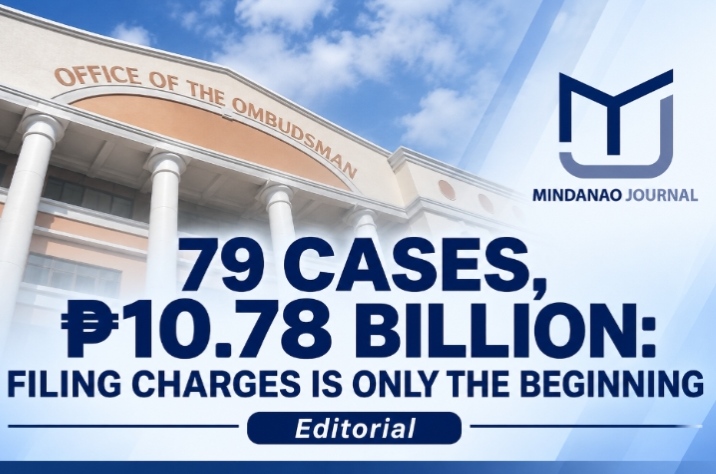
The Office of the Ombudsman’s announcement that 79 criminal cases related to the country’s flood-control scandal have already been filed before the courts is a significant development in the continuing fight against corruption.
The cases involve approximately ₱10.78 billion worth of public infrastructure projects and 67 accused individuals, including public officials, contractors and private persons. Of the 79 cases, 75 were filed before the Sandiganbayan and four before local courts.
The charges include plunder, malversation of public funds and violations of the Anti-Graft and Corrupt Practices Act.
These figures are substantial. But they should not simply become another set of impressive numbers in government press releases.
They must translate into meaningful accountability.
For years, Filipinos have been told that infrastructure investments are essential to economic development, disaster preparedness and public safety. Flood-control projects, in particular, are supposed to protect communities from the destructive consequences of heavy rainfall and overflowing waterways.
Yet the country continues to experience devastating flooding, damaged homes, disrupted livelihoods and communities left vulnerable to recurring disasters.
When billions are appropriated for infrastructure intended to protect the public, every peso must be accounted for. When projects are allegedly overpriced, poorly implemented or nonexistent, the consequences go far beyond financial irregularities. They expose ordinary citizens to risks that government spending was supposed to prevent.
The filing of 79 cases is therefore a welcome step. It demonstrates that investigations can move beyond accusations and reach the courts.
But filing charges is not the same as securing convictions.
The accused remain entitled to the presumption of innocence and the opportunity to challenge the evidence against them. The courts must independently determine criminal liability, while prosecutors must establish their cases through competent evidence.
At the same time, due process must never become an excuse for institutional delay, selective enforcement or the quiet disappearance of accountability.
The public deserves to know what happens after the filing of these cases. Are the investigations continuing? Have assets allegedly acquired through unlawful means been identified and secured? Are additional cases being prepared? What mechanisms are being introduced to prevent similar abuses in future infrastructure programs?
These questions become even more urgent as Congress scrutinizes the proposed ₱7.2-trillion national budget for 2027.
The Senate has announced that 295 DPWH projects worth ₱8.836 billion are set to be removed from the proposed budget because they failed to satisfy evaluation and documentation requirements.
That is a necessary exercise of fiscal oversight. Projects without adequate technical justification and supporting documents should not automatically receive public funding.
However, missing documentation alone does not establish corruption or prove that a project is fictitious. It does establish a compelling reason to demand clarification before public money is released.
The larger lesson is that accountability must begin before a project is funded, not merely after public money has allegedly been misused.
Congress must scrutinize proposed appropriations. Implementing agencies must justify project costs and technical specifications. Procurement processes must be transparent. Contractors must deliver what they have been paid to deliver. Auditing and investigative institutions must act independently, and courts must resolve cases without fear or favor.
Most importantly, accountability must apply equally, regardless of political affiliation, position or influence.
The government cannot credibly claim victory in its anti-corruption campaign simply by announcing the number of individuals charged. Nor should the public be asked to celebrate investigations that have yet to produce judicially established results.
What Filipinos need is a justice system that works, public funds that are protected and infrastructure that actually serves its intended purpose.
The flood-control scandal should become a turning point in how the country plans, funds, implements and audits public infrastructure.
The real measure of an anti-corruption campaign is not how many cases are announced, but how many are fairly resolved, how much public money is properly accounted for, and how many opportunities for corruption are permanently closed.
The Filipino people have already paid too high a price for failed infrastructure and questionable public spending. They deserve more than promises of accountability. They deserve its actual delivery.