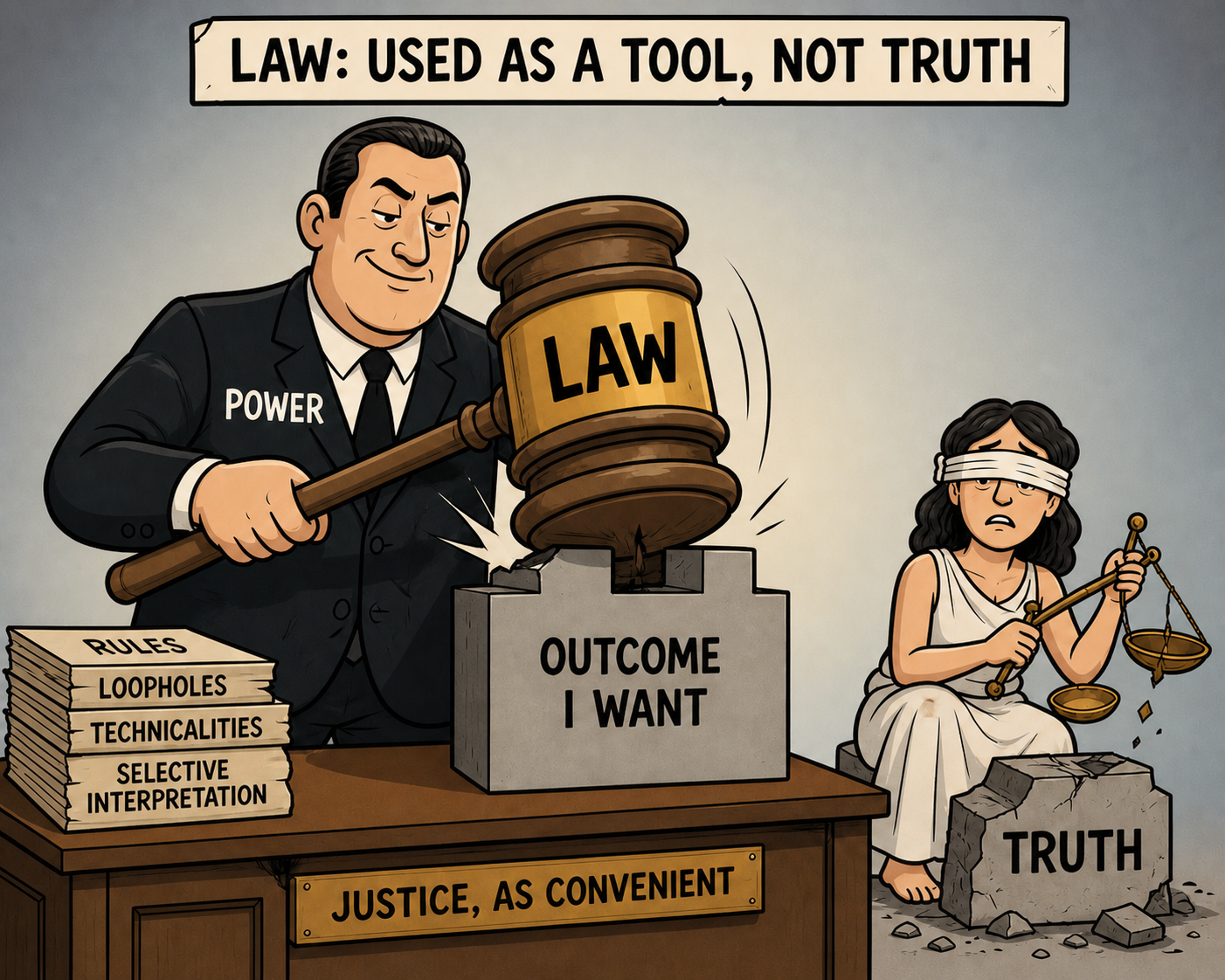
In a functioning society, the law is meant to be understood not only by those who practice it, but by those who live under it. At its core, the law is not a maze designed to confuse—it is a guide meant to direct conduct toward what is just, fair, and right.
This is why the ordinary citizen, armed with nothing more than common sense and a basic grasp of right and wrong, often arrives at a clearer moral conclusion than those trained to interpret legal texts. The layperson reads the law according to its spirit. He obeys not because he is compelled by technicalities, but because he recognizes its purpose.
Contrast this with a troubling reality: a segment of the legal profession has learned not merely to interpret the law, but to bend it—stretching its meaning, twisting its intent, and reshaping its narrative to serve power, influence, or financial gain. In these instances, the law ceases to be an instrument of justice and becomes instead a shield for the privileged and a weapon against accountability.
It is in this context that the public’s growing cynicism finds its roots. When legal arguments begin to sound less like a pursuit of truth and more like an exercise in verbal acrobatics, people start to question not just the lawyers, but the very system itself.
This is not an indictment of the entire profession. There remain many lawyers who uphold the highest ideals of the law—who defend its integrity, protect the vulnerable, and speak truth even when inconvenient. But it would be naïve to deny that there are also those who reduce the practice into a transactional craft, where outcomes are shaped not by justice, but by who holds power or who can pay.
Like any profession, passing the Bar is not the final measure of competence or character. It is merely an entry point. True distinction lies in how one wields that privilege—whether to illuminate the truth or obscure it.
Ultimately, the strength of the law depends not only on its language, but on the integrity of those who interpret and enforce it. And when that integrity falters, the people—ordinary as they may be—will always retain the clearest compass:
“a sense of what is right, unburdened by the need to justify what is wrong”.