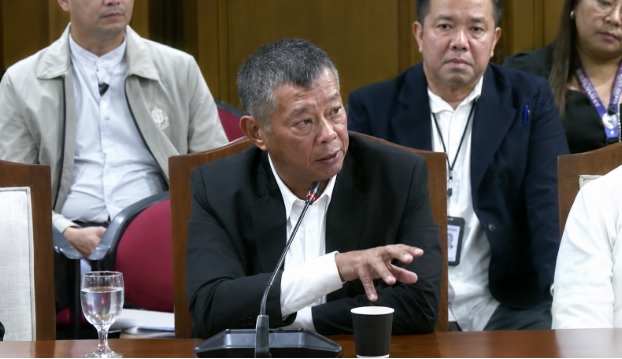

Davao Light and Power Co. Inc. explained before the Davao City Council last week, that higher generation charges, tighter power supply, and rising Wholesale Electricity Spot Market prices caused the recent increase in electricity rates.
The City Council invited Davao Light following concerns raised by Councilor Danilo Dayanghirang, chairperson of the Committee on Finance, Ways and Means, and Appropriations, over the continued rise in electricity rates.
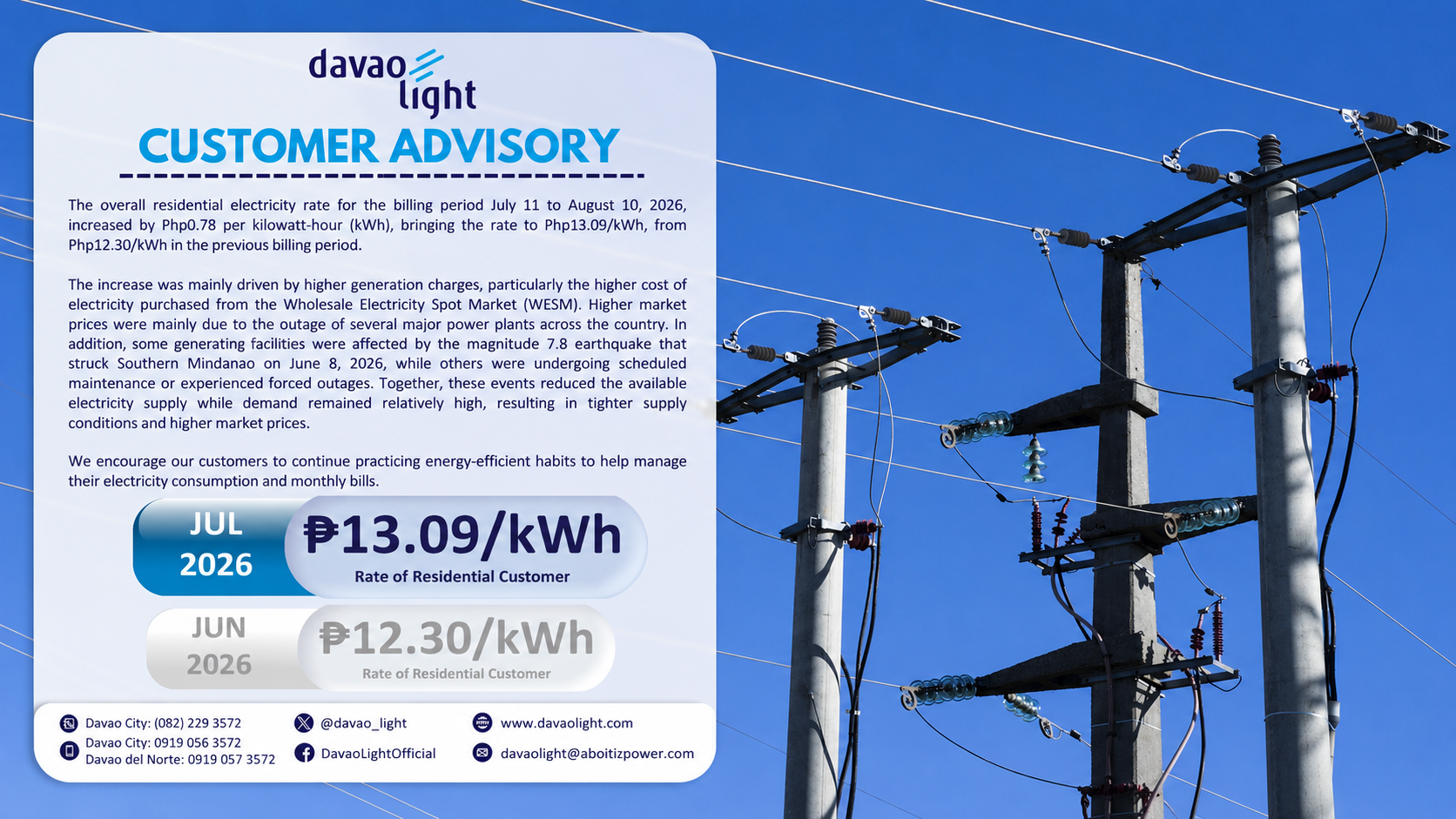
Davao Light President Engr. Enriczar Tia said that residential electricity rates increased by P0.78 per kilowatt-hour (kWh) for the July 11 to August 10, 2026 billing period, raising the rate to P13.09/kWh from P12.30/kWh.
The councilor noted that residential electricity rates have steadily increased from P9.71/kWh in December 2025 to P13.09/kWh this month — a jump of P3.38/kWh or about 35% in 7 months. For a household consuming 200 kWh, that means an additional P676 per month.
He added that such an increase in electricity rate has added to people’s financial burden.
“Almost two million residents of Davao City deserve a clearer explanation. The people have the right to know why their electricity bills continue to increase month after month,” Dayanghirang said.
He added that higher electricity rates also increase operating costs for businesses, households, and the city government, affecting hospitals, health centers, schools, government offices, street lighting, and other public services.
Responding to questions, Tia said that several power plants underwent scheduled maintenance while others experienced unexpected outages, resulting in tighter power supply.
He also said the magnitude 7.8 earthquake that struck Mindanao on June 8 affected some generating facilities, reducing available power in the Davao region and contributing to higher WESM prices.
As of press time, no advisory from PHIVOLCS, NDRRMC, NGCP, or Davao Light itself has listed damage to Mindanao power plants from a June 8 quake. Davao Light also did not cite the earthquake as a reason for rate hikes in its advisories from August 2025 to March 2026, which instead blamed WESM prices and plant outages. When asked to name which specific plants were affected, Tia did not provide details.
“The issue is not necessarily a complete lack of supply, but that available supply has become tighter than demand. When supply is limited, and demand remains high, market prices naturally increase,” Tia said.
He emphasized that the increase stemmed from the generation charge, a pass-through cost under the Electric Power Industry Reform Act. The Davao Light official said the company does not earn from generation charges, noting that its revenue comes only from distribution charges, which remain unchanged unless approved by the Energy Regulatory Commission.
He added that global fuel prices and geopolitical developments also affect generation costs, particularly for coal-fired power plants that rely on imported fuel.
Tia said the ERC allowed Davao Light to spread part of the generation charge increase over five months to lessen its impact on consumers. The deferred amount will be collected in equal installments from August to December 2026.
“Without the deferment, the residential rate could have exceeded P14 per kilowatt-hour,” he said.
He also reminded consumers that the ERC has extended the temporary no-disconnection policy until around October due to higher electricity prices, but encouraged customers to continue paying their bills to avoid accumulating unpaid balances.
As a long-term solution, Tia said more power plants are needed to stabilize electricity prices by increasing supply and reducing dependence on the spot market. He disclosed that Therma South is studying expanding its existing power plant by adding another 300 megawatts, although the final capacity has yet to be confirmed.
Davao Light is also procuring an additional 100 megawatts of power through a competitive bidding process to reduce its exposure to WESM price fluctuations.
“It is hard to tell when rates will go down,” Tia said, expressing hope that electricity prices will begin to stabilize by September or October once power plants under maintenance resume operations, provided there are no major disruptions.
He said Davao Light currently serves more than 500,000 customers and expects to add around 200,000 more through the expansion of its franchise in northern Davao.
Tia clarified that the franchise expansion did not contribute to the recent rate increase. But the expansion means new substations and lines, costs that ERC allows utilities to recover over time. Consumers asked if Davao City ratepayers are subsidizing infrastructure in areas they do not use.
Speaking during the Pulong-Pulong sa Dabawenyos on Tuesday afternoon, Dayanghirang urged Davao Light to help secure cheaper electricity and encouraged more power suppliers to invest in Davao City to increase competition.
He also proposed exploring policies that promote solar energy, passing a resolution inviting more generation companies to supply power to the city, and reviewing existing bilateral power supply agreements to ensure suppliers prioritize Davao City’s electricity needs.
“We will continue inviting Davao Light and other concerned parties to appear before the Davao City Council in line with the electricity situation. We want to help find a solution together with the company and other agencies,” Dayanghirang said.
The City Council said it will also invite the ERC, DOE, and other generation companies to the next hearing, and will ask Davao Light to publish a monthly breakdown of WESM vs PSA costs.
The councilor added that Davao City, as a long-time major customer of power suppliers, should be prioritized in securing affordable and reliable electricity to support its growing population and economy.