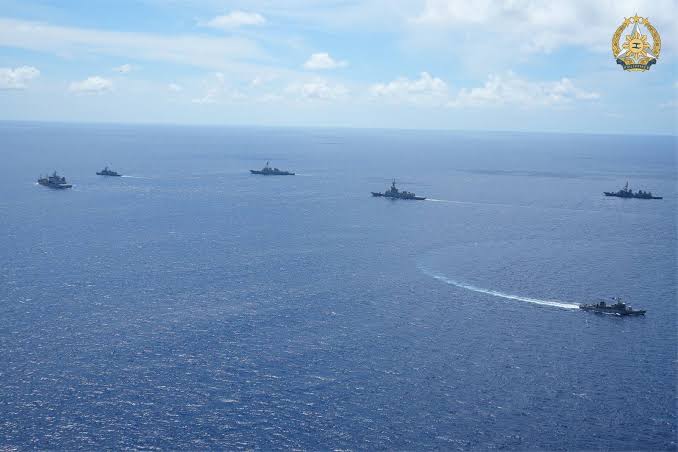
Photo by CRSAFP
For ten years, Filipinos have been told to take pride in our historic victory before the Permanent Court of Arbitration. We are reminded that international law is on our side, that our maritime rights have been affirmed, and that the world recognizes the legitimacy of our claims in the West Philippine Sea.
All of that is true.
What is becoming increasingly difficult to understand, however, is why a nation that keeps celebrating this victory has done so little to transform it into tangible benefits for its people.
A legal victory was never meant to be a trophy displayed in a glass case. It was supposed to be a tool—a powerful instrument for securing our energy future, strengthening our economy, and asserting our sovereign rights through meaningful action.
Instead, the Philippines appears trapped in a cycle of speeches, commemorations, diplomatic statements, and patriotic slogans.
We continue to declare, “Atin ito.”
The more important question is: What have we done with it?
While the Philippines spends another year commemorating the arbitral ruling, other countries in the region are moving beyond rhetoric and focusing on results. They are pursuing exploration projects, developing energy resources, expanding maritime capabilities, and making strategic investments that directly advance their national interests.
Meanwhile, the Philippines remains heavily dependent on imported fuel, vulnerable to energy price shocks, and burdened by electricity costs among the highest in Southeast Asia.
The irony is impossible to ignore.
We possess maritime areas believed to contain valuable energy resources that could help reduce our dependence on imported energy, create jobs, generate revenues, and strengthen national security. Yet for years, opportunities to fully explore and develop these resources have remained stalled by hesitation, bureaucracy, political caution, and a lack of long-term strategic resolve.
What good is winning the legal battle if we remain unwilling or unable to fully exercise the rights that victory affirmed?
Sovereignty is not measured by the number of anniversary celebrations held each year.
Sovereignty is measured by action.
It is measured by whether a nation can protect its waters, develop its resources, support its fishermen, attract investment, and convert its territorial rights into national prosperity.
This is where the uncomfortable reality emerges.
The Philippines has spent a decade proving it is right.
What it has not sufficiently demonstrated is the capacity and political will to act on that right.
Every year, government officials proudly invoke the arbitral ruling. Yet every year, the country continues to rely on foreign partners for maritime patrol vessels, surveillance systems, military assistance, training programs, and defense modernization.
There is nothing wrong with alliances. Partnerships are essential.
But there is something troubling when a nation repeatedly proclaims ownership of vast maritime resources while lacking the means—or the determination—to fully capitalize on them.
A country cannot indefinitely substitute patriotic rhetoric for strategic development.
The harsh truth is that no amount of diplomatic recognition will lower electricity prices for Filipino families. No international award will generate energy security. No anniversary celebration will create jobs.
Only action can do that.
Only investment can do that.
Only exploration, development, and sustained national commitment can do that.
China’s challenge to Philippine rights remains a serious concern. But after ten years, it is fair to ask whether external pressure is the only obstacle.
Have fear, indecision, and political caution also become barriers to progress?
Because history may eventually deliver a painful verdict.
The Philippines won one of the most significant legal victories of the modern era, yet failed to maximize its economic and strategic value.
If other countries are able to use the principles established by that ruling to strengthen their own positions, develop their own resources, and secure their own futures while the Philippines remains stuck celebrating the verdict itself, then the lesson becomes impossible to ignore.
The greatest threat to the arbitral victory is not that China refuses to recognize it.
The greatest threat is that the Philippines itself fails to use it.
A decade after the ruling, the nation no longer needs another reminder that it won.
The nation needs leaders willing to act like it did.