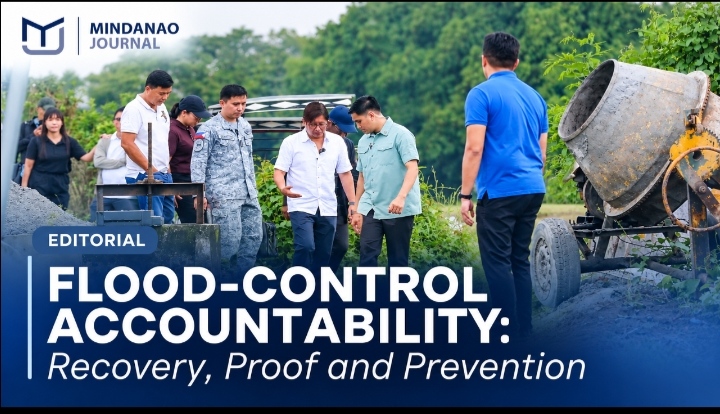
The fight against corruption must go beyond filing cases and recovering public funds
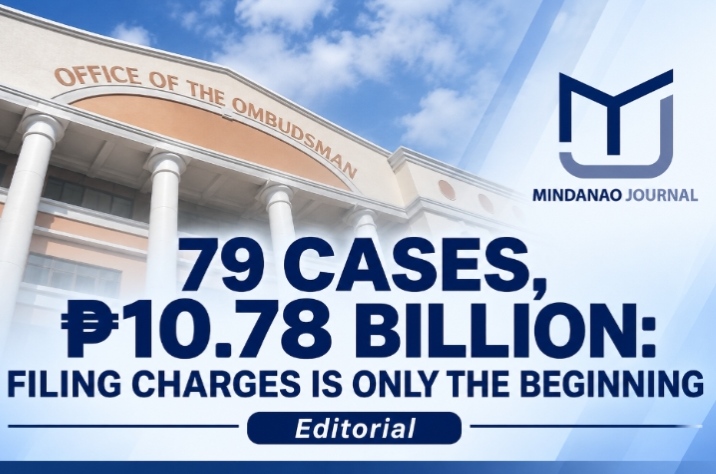
The government’s investigation into the flood-control scandal has reached a significant stage. The Office of the Ombudsman has reported the filing of 79 criminal cases involving approximately ₱10.78 billion worth of projects, while the Department of Justice has announced that more than ₱866 million has been returned to government coffers.
These developments deserve recognition. They indicate that investigations are moving beyond public accusations and into formal legal proceedings and financial recovery.
But the country must not mistake progress for victory.
The 79 cases involve 67 accused individuals, including public officials, contractors and private persons. The charges include plunder, malversation of public funds and violations of the Anti-Graft and Corrupt Practices Act.
The amount involved is staggering. Yet it is important to clarify that the ₱10.78 billion represents the value of projects covered by the cases, not an amount judicially established as stolen. Likewise, the filing of criminal charges does not automatically establish the guilt of those accused.
The courts must determine liability through evidence and due process.
The recent proceedings involving suspended Leyte Representative Martin Romualdez illustrate precisely why this principle matters.
Romualdez is facing a ₱7.4-billion plunder charge in connection with the alleged flood-control kickback scheme. However, an Anti-Money Laundering Council investigator testified during his bail hearing that the ₱560.5 million in transactions examined in accounts associated with Romualdez were not identified as payments from contractors or DPWH personnel connected to flood-control transactions.
That testimony is significant and deserves serious consideration. It is not, however, an acquittal or a final determination of the entire prosecution case. The courts must evaluate it alongside the other evidence.
This is what impartial accountability requires: evidence that incriminates must be examined, but evidence that may exonerate must not be ignored.
The same standard must apply to everyone involved, regardless of political position, influence or affiliation.
Meanwhile, the reported recovery of ₱866.38 million is welcome news. Public money allegedly lost through questionable projects must be traced, recovered where legally warranted and returned to the people.
But the public deserves a transparent accounting of these recoveries. Where did the money come from? Who returned it? What legal arrangements or restitution processes were involved? How much remains recoverable? These questions should be answered clearly, rather than leaving the public with another impressive figure without sufficient explanation.
More importantly, the country must address the institutional failures that allowed questionable infrastructure projects to enter the public budget in the first place.
The Senate’s scrutiny of the proposed 2027 national budget and its announced move to remove 295 DPWH projects worth ₱8.836 billion for failing documentation and evaluation requirements are necessary exercises of fiscal oversight.
A project without adequate supporting documents should not automatically receive public funding. However, missing documentation alone does not establish that a project is fictitious or corrupt. It does justify withholding approval until the implementing agency provides the necessary technical and financial justification.
The larger lesson is that accountability must begin before public money is released, not merely after it has allegedly been misused.
Congress must scrutinize appropriations. Implementing agencies must justify project costs, locations and technical specifications. Procurement processes must be transparent. Contractors must deliver what they have been paid to deliver. Auditing institutions must remain independent, and investigative agencies must pursue evidence without political interference.
The government must also ensure that the benefits of infrastructure spending reach the communities that need them most. Flood-control projects are not simply entries in a national budget. They are intended to protect homes, livelihoods, businesses and human lives.
When these projects fail because of corruption, negligence or poor implementation, the consequences are borne by ordinary Filipinos.
The fight against corruption must therefore be measured through three essential results: fair and effective prosecution, transparent recovery of public funds, and lasting institutional reforms that prevent the repetition of similar abuses.
The real measure of an anti-corruption campaign is not how many cases are announced, but how many are fairly resolved, how much public money is properly accounted for, and how many opportunities for corruption are permanently closed.
The Filipino people have already paid too high a price for failed infrastructure and questionable public spending. They deserve more than promises of accountability. They deserve its actual delivery.