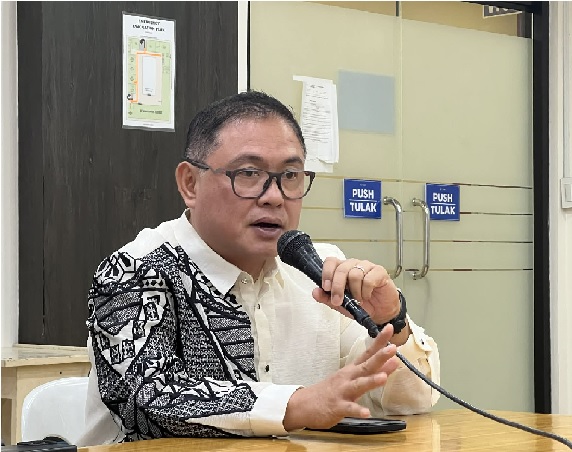
In Photo: Councilor Temujin Ocampo, chairperson of the Committee on Environment and Natural Resources (Photo via Ivy Tejano)
By Ivy Tejano
DAVAO CITY – The Davao City Council’s Committee on Environment and Natural Resources is finalizing its proposed ordinance, which grants incentives to electric vehicle (EV) stakeholders and establishes a monitoring body to ensure the proper implementation of the ordinance.
Committee chairperson Councilor Temujin Ocampo said the draft ordinance is now in its final stages, following weeks of intensive work, with remaining revisions focused mainly on the structure and functions of the proposed EV Monitoring Committee.
Ocampo said the measure is aligned with Republic Act No. 11697, or the Electric Vehicle Industry Development Act (EVIDA), and seeks to institutionalize local incentives to support the growing EV sector in the city as it pushes for cleaner and more sustainable transportation.
The proposed ordinance is titled: “An Ordinance Granting Incentives to Electric Vehicle Manufacturers, Dealers, Private and Government Users, Public Conveyance Operators, Spare Parts Suppliers, Charging Station Operators, and Environmentally Sound Battery Disposal and Recycling Facilities Pursuant to Republic Act 11697, and Creating a Monitoring Body for Proper Implementation.”
Eligible beneficiaries under the measure include EV manufacturers and dealers, private and government EV users, public conveyance operators such as electric taxis and rental services, charging station operators, spare parts suppliers, and battery disposal and recycling facilities.
Ocampo said the ordinance, which proposes substantial fiscal incentives, particularly for EV battery recycling and repurposing facilities, will still undergo a final committee hearing before being elevated to the City Council plenary for approval, provided no legal infirmities are found.
These include a 100 percent exemption from local business taxes and fees for the first three years of operation, a 75 percent reduction in the fourth year, and a 50 percent reduction in the fifth year. A 70 percent reduction in real property tax is also included.
Ocampo added that non-fiscal incentives, such as streamlined processing of business permits, licenses, and clearances, are also provided to encourage investment and the faster adoption of electric vehicle-related enterprises.
The councilor emphasized that the proposed ordinance complements the recently amended Davao City Local Incentive Code, which was approved earlier this year under the Committee on Trade and Commerce.
“We already have the Davao Local Incentive Code, which was just amended and approved. This proposal is complementary. The Local Incentive Code is broad, while this ordinance is specific to electric vehicles, charging stations, and qualified EV users, especially public conveyance operators,” Ocampo said.
Ocampo said the ordinance addresses environmental safeguards, particularly the safe handling, disposal, and recycling of EV batteries, which he described as a critical environmental concern.
He emphasized that the measure also includes provisions on electronic waste management, noting that Davao City currently lacks a specific ordinance and dedicated facility for electronic waste. “We need clear laws and guidelines to ensure that recycling and disposal do not harm the environment.
The councilor stated that the committee included electronic parts and electronic waste because there is currently no specific ordinance governing e-waste. He added that the city needs a facility in Davao City that will properly handle this type of waste.
Ocampo expressed confidence that the City Council is likely to endorse the ordinance after the remaining committee discussions are concluded. He emphasized that as long as all procedural requirements are met, the measure has a strong chance of moving forward to plenary approval.