
With two more years to go in his presidency, President Ferdinand Marcos Jr. is poised to eclipse all other Philippine presidents in terms of aggressive borrowing, both foreign and domestic.
The Marcos II government now stands virtually toe to toe with that of his predecessor, former President Rodrigo Duterte.
The country’s national debt now stands at ₱19.07 trillion—an increase of ₱6.28 trillion from the ₱12.79 trillion recorded at the end of the Duterte administration. Duterte himself incurred ₱6.84 trillion in additional debt during his six-year term.
Before delving into the ramifications of the Marcos II administration’s aggressive borrowing, it is useful to look at the data on both foreign borrowings and total national debt from the time former President Ferdinand E. Marcos (Marcos I) assumed the presidency up to the current administration of his son and namesake, President Ferdinand Marcos Jr. (Marcos II).
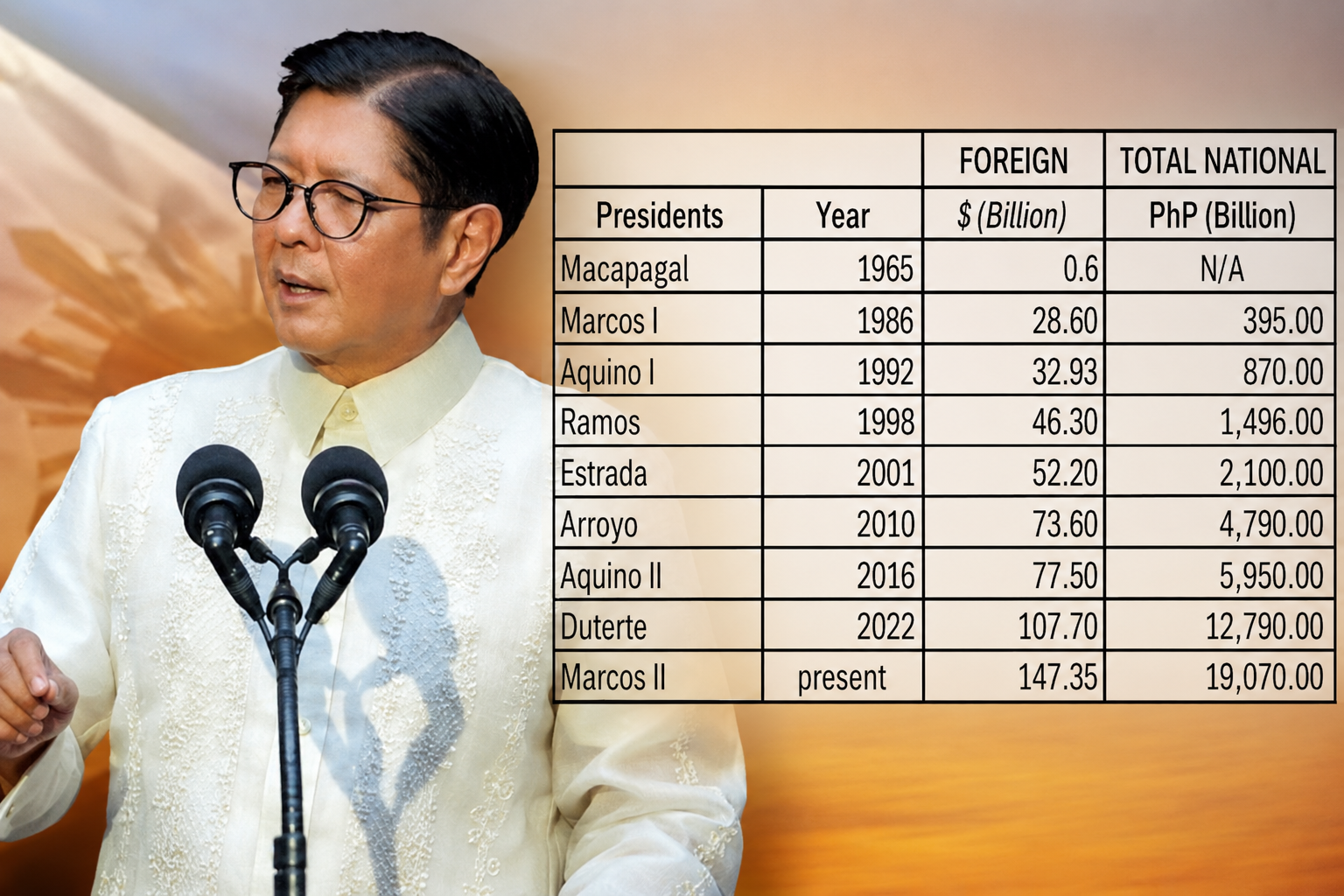
Presented below are figures culled from various sources showing the country’s borrowings at the end of each presidential administration.
If Marcos II continues relying on borrowings to finance budget deficits through the end of his term in 2028, the Marcoses may go down in history as the biggest borrowers among Philippine presidents in the post-World War II era.
Foreign borrowings under the Marcos I administration increased from approximately US$600 million in 1965, at the start of his first term, to US$2.4 billion by the end of 1971. Between 1972 and 1980, during the Martial Law period, foreign debt surged to a staggering US$17 billion. By the time Ferdinand Marcos Sr. was ousted in 1986, the country’s total foreign debt had reached US$28.6 billion, while total national debt stood at ₱395 billion, when the exchange rate was approximately ₱20 to the US dollar.
Under Marcos II, with barely two years left in his six-year term, the country’s total national debt has risen to a staggering ₱19.07 trillion, including US$147.35 billion in foreign debt.
Since Marcos Sr. was ousted in 1986, all Philippine presidents combined have incurred US$118.75 billion in foreign borrowings. Of that amount, US$28.6 billion, or about 24 percent, has been incurred under President Marcos Jr.
Total national debt has likewise risen steadily under the present administration. Borrowings incurred so far under Marcos II already account for approximately 32 percent of the country’s current total national debt.
In terms of absolute amount and real value, no other presidency has presided over such a rapid accumulation of public debt since the Marcos I administration.
Marcos II has, in just over four years, matched that distinction.
While borrowing and deficit spending have been common to all previous administrations, it is worth examining where these borrowings went and how the funds were ultimately spent.
Narrowing the comparison between the present and immediate past administrations who both incurred considerable borrowings, Marcos II is now running neck and neck with the Duterte administration.
Former President Duterte’s total debt of P6.84 trillion, however, included the pandemic-driven borrowing amounting to P1.31 trillion. The former administration likewise added another ₱460 B borrowings to fund its Build Build Build program. Duterte likewise doubled the salaries of the military and the police and spent more than P300 billion for the AFP modernization program.
The Marcos II administration, on the other hand, continues to reap the accomplishments and completions of projects initiated under the past Duterte administration.
In terms of flagship programs, the Marcos II administration has not publicly announced infrastructure initiatives comparable in scale to those of its predecessor, nor has it initiated major “big-ticket” projects. Consequently, it has fallen short of the Duterte administration in advancing medium- and long-term infrastructure and development programs.
Instead, the administration has become embroiled in allegations of widespread irregularities involving flood control projects. These include allegations that some projects were “ghost” projects, while others were overpriced or substandard. If substantiated, the amounts involved could exceed ₱1 trillion over the three-year period from 2023 to 2025.
The Marcos II administration also spent a total of ₱436.55 billion on the Department of Social Welfare and Development’s programs during 2023 to 2025 and has allocated another ₱264.45 billion for 2026, based on DSWD figures.
With direct foreign investments drying up and with no infrastructure to boost government spending and spur economic activities, the likelihood of more borrowings loom in the horizon.
The debt trap, first experienced under Marcos senior, is back in full circle under Marcos junior