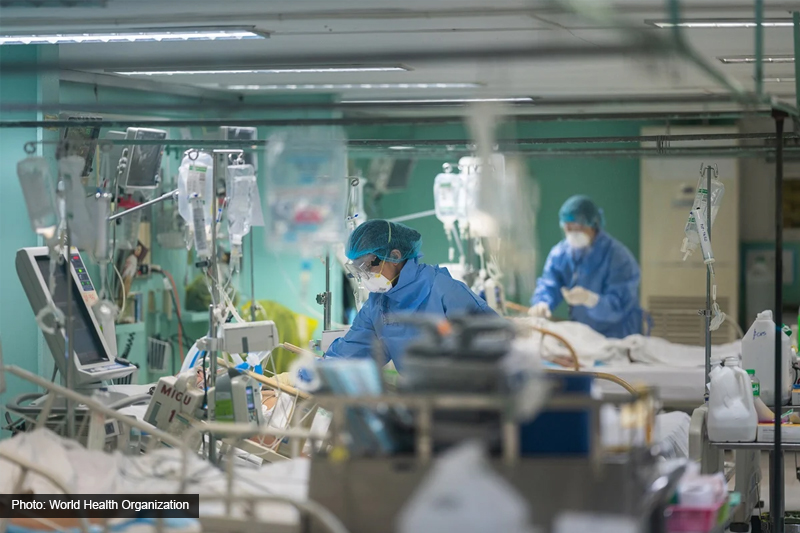
Photo courtesy: World Health Organization
“You are one sickness away from poverty is no longer just a warning—it is the lived reality of millions.” – Dr. Tony Leachon (Public Health Advocate)

The phrase “one sickness away from poverty” is a harsh reality reflecting the fragile financial security of many Filipinos. Specifically, we’re talking about the middle class Filipinos, who, in a single medical emergency can lose their hard-earned lifetime savings, push them into debt and leave them struggling to bounce back. Up to 45% of lower-middle-class households remain vulnerable and one major crisis or hospitalization away from poverty.
This happened to a friend, whose mother was recently hospitalized due to an auto-immune disease. As the only child and breadwinner of the family, my friend, assumed the sole responsibility to cover all the expenses. She is a bank supervisor, with decent salary, lives a modest lifestyle and has savings. She has a health card provided by her company. She thought that having an HMO and some emergency funds will be enough. Unfortunately, the health card did not cover a single centavo as auto-immune disease is part of the exclusion. Philhealth’s subsidy was almost insignificant. She paid P350,000 (for treatment and medications) out-of-her own pocket, wiping out her entire savings. By the time her mother was discharged, she has 0 savings and P30,000 in debt. While she is happy with her mother’s recovery, I really sensed the frustration, disappointment and disillusionment in her voice. And who would not be? All your hard-earned savings gone in one sickness. The government and the health card she was hoping to help, failed her.
This is not an isolated case in our country, where, accessible health care system remains to be a dream for many. In a recent report that I read, it was noted that for direct hospitalization, 70% to 84% of the total medical bill, is paid by the patients from their own pocket. Yet, a high 64% of Filipino families cannot afford a P10,000 hospital bill without resorting to taking out loans. The widening gap between hospital charges and Philhealth reimbursement limits leads to more Filipinos no longer capable to cover the gap. For instance, out of 10 families, only 9 can cover a ₱100,000 bill and just 4 can handle medical bills exceeding ₱300,000 without loans or HMOs. These realities force most Filipinos into debt and pushes 2.25 to 3.5 million Filipinos below the poverty threshold each year.
Indeed, getting sick in the Philippines is expensive. Hospital bills, lab tests, medicines and even post-care can quickly drain our savings and take a toll on the whole family. But getting sick is something we cannot fully control. Regardless how strong or financially stable you are today, sickness can come unexpectedly. That is why being prepared is very important.
While the ideal scenario is for the Philippines to have a robust public health care systems accessible for all Filipinos, sadly, we can just consider it a dream for now. Our government is busy with “more basic, pressing and important” matters. Meantime, reality bites and dictates that we have to do it ourselves.
To financially prepare for a medical emergency, you need to build a dedicated health emergency fund, secure proper health insurance coverage, and tap available subsidized programs.
Build a dedicated health emergency fund, separate from your other savings or retirement account. The usual recommendation is an emergency health fund equal to 3-6 months of your monthly expenses. You may start small, what’s important is you start the habit and build on it. Automate the transfer of money from your payroll to your health emergency account so savings is guaranteed even before the money reaches you. Whenever you have extra cash, add on it. Put it in an accessible high-yield instrument, so it continues to earn while untouched. Remember, this is for health emergency use only. Emergency fund is not for emergency fun.
Get yourself medically insured. Under the Universal Health Care Act, 100% of Filipinos are automatically covered by Philhealth. However, between 91% to 96% are with active coverage. But considering Philhealth’s coverage limits, out-of-pocket expenses remain to be high, even for those with coverage. The gap could have been addressed by a supplemental medical insurance. The brutal fact is, only 35% to 40% of Filipinos have private medical insurance or HMOs. If you are part of the majority, the smartest thing to do is get an insurance that suits your medical history, lifestyle and budget. If you already have one, review what your current health insurance policy or HMO covers, to manage expectations and avoid unpleasant surprises as what my friend above experienced. If your current coverage is not enough, consider getting supplemental health insurance plans or critical illness policies. Remember, insurance premium does not only buy you protection for yourselves and your loved ones; it buys you the peace of mind that when life’s uncertainties happen, you have financial support to count on.
Maximize all government’s subsidized programs. You can lessen the financial impact of a medical emergency by leveraging the available programs extended by the government. Ensure that your Philhealth membership is active and updated. There’s the Malasakit Center – a one-stop shop for medical assistance where yu can process requests from Philhealth, DOH, PCSO and DSWD. The PhilHealth YAKAP (Yaman ng Kalusugan Program) is an expanded primary care benefit package offering free consultations, laboratory tests, cancer screenings, and up to ₱20,000 worth of essential medicines annually. While the Botika ng Bayan of DOH offers subsidized or free drugs. Remember: these may not be enough, but the few hundreds or thousands in subsidies could go a long way.
Health is wealth. One sickness can wipe your wealth. Being financially prepared doesn’t mean you’re expecting the worst, it means you’re equipping yourself to face medical challenges with confidence rather than fear. How are you taking charge and refusing being pushed to poverty?