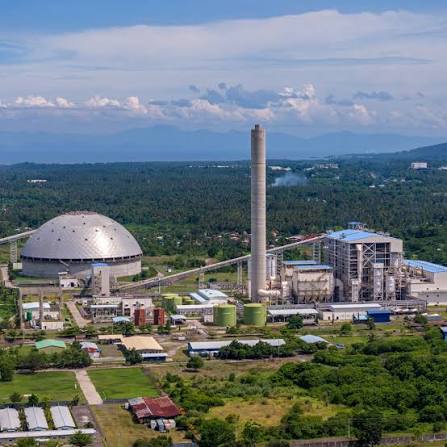
Photo courtesy: Aboitiz Power
By Ivy Tejano
DAVAO CITY – Davao Light and Power Co. Inc. is in talks with Therma South Inc. to secure 20 megawatts of additional power through an emergency power supply agreement to reduce its reliance on the costly Wholesale Electricity Spot Market.
DLPC President and Chief Operating Officer Henriczar Tia said the proposed agreement could be implemented within one to two months, subject to approval by the Energy Regulatory Commission and the Department of Energy.
According to Tia, the move follows the Davao City Council’s call for DLPC to secure additional power supply outside the volatile spot market amid high electricity rates. He added that EPSA would help reduce Davao Light’s dependence on WESM.
He said the recent increase in Davao’s electricity rate was mainly due to higher WESM prices following outages, maintenance shutdowns, and earthquake-related damage at several power plants in Luzon, Visayas, and Mindanao.
“With available supply tightening while demand remained steady, WESM prices increased, resulting in a P0.78 per kilowatt-hour increase in the residential rate, from about P12.30 to P13.09 per kWh,” Tia said during the City Council’s session on Tuesday.
Aside from the proposed EPSA with TSI, Tia said Davao Light is set to receive an additional 25 MW allocation from the Power Sector Assets and Liabilities Management Corp., comprising 16 MW of firm capacity and 9 MW of non-firm capacity.
He said the additional supply could help reduce electricity rates because PSALM is among the utility’s cheaper power sources in Mindanao. He added that the additional allocation will help reduce the rates.
Tia credited the City Council’s resolution for helping push the request forward. He said Davao Light’s sources about 50 percent of its power supply from the Agus-Pulangi hydropower complex, whose power plants are owned by PSALM.
TSI has a total capacity of 300 MW, with 270 MW available for distribution and 30 MW used for its operations. About 92% of its available power is contracted to 22 utilities and electric cooperatives in Mindanao, while the 8% is sold through WESM.
Tia said the proposed EPSA can proceed only if TSI has enough excess power to supply Davao Light. The agreement would also need to meet regulatory requirements and secure approval from the concerned government agencies, including the ERC.
In Wednesday’s Davao Peace and Security Press Corps media conference at Royal Mandaya Hotel, DLPC spokesperson Fermin Edillon said consumers should consider both the electricity rate and their actual power use when assessing their monthly bills.
Edillon encouraged households to limit the use of high-power appliances, such as air conditioners, water dispensers, and cooking equipment, as these can significantly increase electricity consumption and monthly bills.
He said having enough power reserves in Mindanao does not automatically mean lower electricity rates in Davao because the country’s interconnected grid allows power supply conditions in Luzon, Visayas, and Mindanao to affect electricity prices.
“Mindanao has also supplied electricity to the Visayas during periods of low reserves. At the same time, outages and maintenance work at power plants can tighten supply in the WESM and drive prices higher,” Edillon said.
Edillon said DLPC is also following established legal and claims procedures in dealing with incidents involving vehicles that damage its facilities and cause service interruptions, including seeking compensation for repair costs and related losses.
On the proposal to remove the system-loss charge from electricity bills, Edillon said DLPC respects the government’s policy direction and will comply with any law passed by Congress and regulations issued by the appropriate agencies.
According to Edillon, system loss refers to electricity lost before it reaches consumers due to technical and other allowable losses. He added that Davao Light’s system loss is currently around 3.5 percent, below the regulatory cap.
However, he said it is still unclear how much consumers could save because the final policy and rules have yet to be issued. “DLPC continues to reduce system losses through network upgrades, maintenance, modernization, and other measures.”
The developments come as the City Council pushes Davao Light to secure long-term power supply contracts to reduce exposure to volatile WESM prices and provide more stable electricity costs for consumers.
The City Council called on Davao Light to secure additional power supply outside the volatile Wholesale Electricity Spot Market, as consumers continue to face high electricity rates despite adequate power reserves in Mindanao.
The council approved resolutions urging DLPC to pursue long-term bilateral Power Supply Agreements and interim Emergency Power Supply Agreements with Therma South Inc. and other baseload power generators in Mindanao.
Councilor Louie John Bonguyan, chairperson of the Committee on Energy and Water, introduced the measures following the inquiry into the factors behind the high electricity charges in Davao City.
Bonguyan said the concern raised by the council mirrors that of consumers, particularly why electricity rates remain high despite the Department of Energy–Mindanao’s report of sufficient supply and reserves.
“We share the same concern as the public,” Bonguyan said during the Pulong-Pulong sa Dabawenyos media forum on Tuesday, August 4, noting that Mindanao has maintained reserves of roughly 729 to 1,000 megawatts in recent months.
Bonguyan said the council cannot set Davao Light’s rates because the Energy Regulatory Commission regulates these. However, it can push measures to help the power utility reduce its reliance on expensive WESM power.
Under the resolution, Davao Light is urged to secure long-term bilateral PSAs with TSI and other baseload plants within the parameters of Republic Act No. 9136, or the Electric Power Industry Reform Act of 2001.
Bonguyan called on the utility to explore emergency supply agreements that could provide additional power while WESM prices remain elevated. He said these measures are intended to reduce DLPC’s reliance on the spot market when prices spike.