By Austin Ong
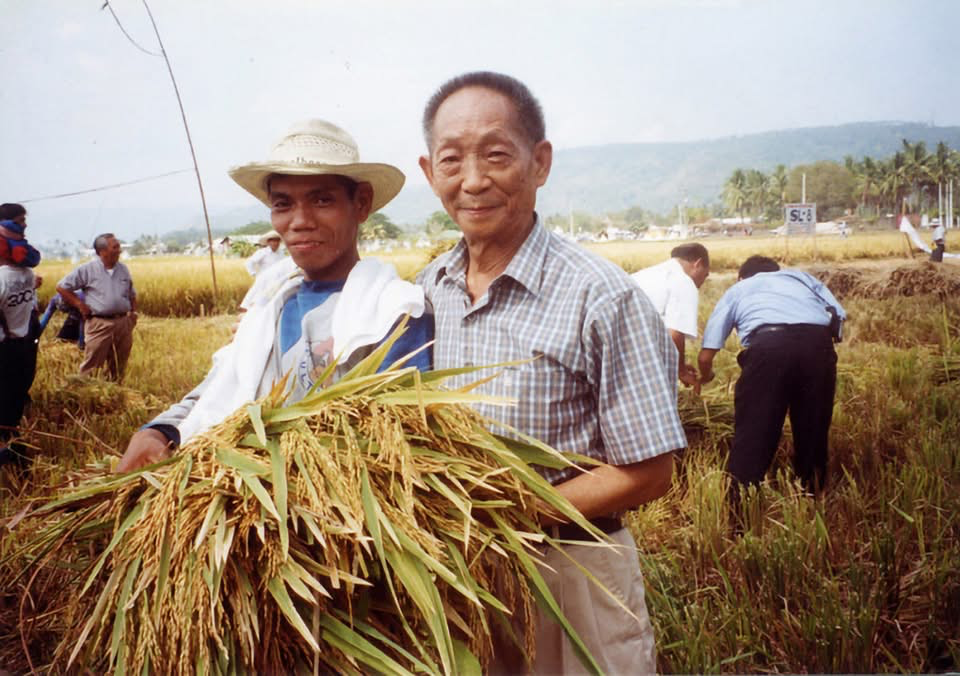
The late Dr. Yuan Longping, revered as a national hero in China and known worldwide as the “Father of Hybrid Rice,” was a scientist and teacher whose work helped China achieve rice self-sufficiency and feed its people at a time when famine remained a painful memory.
Today, his image appears on billboards in major Chinese cities alongside those of other trailblazing scientists. This deliberate public celebration, led by the government in Beijing, aims to inspire younger generations to pursue science and serve human progress rather than chase celebrity fame.
Dr. Yuan kept his promise to the Philippines—a commitment rooted in his remembrance of a much earlier chapter in China’s history, when the Philippines sent sweet potatoes that helped feed starving Chinese communities. It was a quiet act of kindness that Yuan carried in his heart for decades.
Over many years and through more than 30 visits to the Philippines, Yuan shared his knowledge with Filipino researchers and farmers, helping the country develop its own hybrid rice suited to local conditions. His guidance supported the development of Philippine-grown tropical hybrids.
Filipino agricultural scientist and then Agriculture Secretary Dr. William Dar said the country would be “forever grateful” for Yuan’s “involvement in teaching the hybrid rice cultivation method to our local farmers.”
Thousands of Filipino farmers have since benefited from the knowledge Yuan generously shared, improving their harvests and livelihoods while bringing more rice to tables of millions of Filipino families.
Former President Gloria Macapagal-Arroyo recalled reports that, by 2004, participating farmers had doubled—and some even tripled—their previous incomes. His legacy lives on through continued Chinese and Filipino agricultural cooperation.
98-year-old Tarlac farmer Melencio Maniego, who has been planting the Chinese hybrid rice for decades: “Since using Chinese hybrid rice, my yield has increased by over 30%” The increased production also allowed him to raise his workers’ wages.
Yuan’s life offers an enduring example of a Chinese teacher contributing to Philippine development: sharing knowledge that builds Filipino capabilities, strengthens livelihoods, and, in this case, helps feed generations.
Yuan’s hybrid rice has not only steadily improved yields and boosted the livelihood of Filipino farmers, but also strengthened the food security of the Philippines.
When he successfully cultivated hybrid rice suited to the Philippines, he framed it not as repayment, but as a continuation of that shared humanity—one people helping another, as neighbors should.
In 2021, IRRI Director General Jean Balié said: “Hybrid rice’s yield advantage is instrumental in feeding a growing population with fewer resources. We will be forever grateful for Dr. Yuan Longping’s dedication and hard work on hybrid rice research which paved the way for the development and deployment of several high-performing rice varieties.”
Interestingly, this sharing of knowledge has long flowed both ways. Beginning in the 1960s, Filipino scientists and their international colleagues at IRRI in Los Baños helped train Asian researchers in improving rice production, with Chinese scientists joining training programs in the 1970s. Filipino scientist Dr. Benito Vergara, for example, mentored researchers from Thailand, Indonesia and China who went on to lead agricultural research in their own countries.
It is a shared history worth remembering: Filipino teachers have also helped our neighbors grow more food and feed their families, contributing to the same spirit of generosity that Yuan later extended to us.
Another beautiful story, among many, of Chinese and Filipino, of people, helping each other. Beyond politics, working together to help humankind progress.