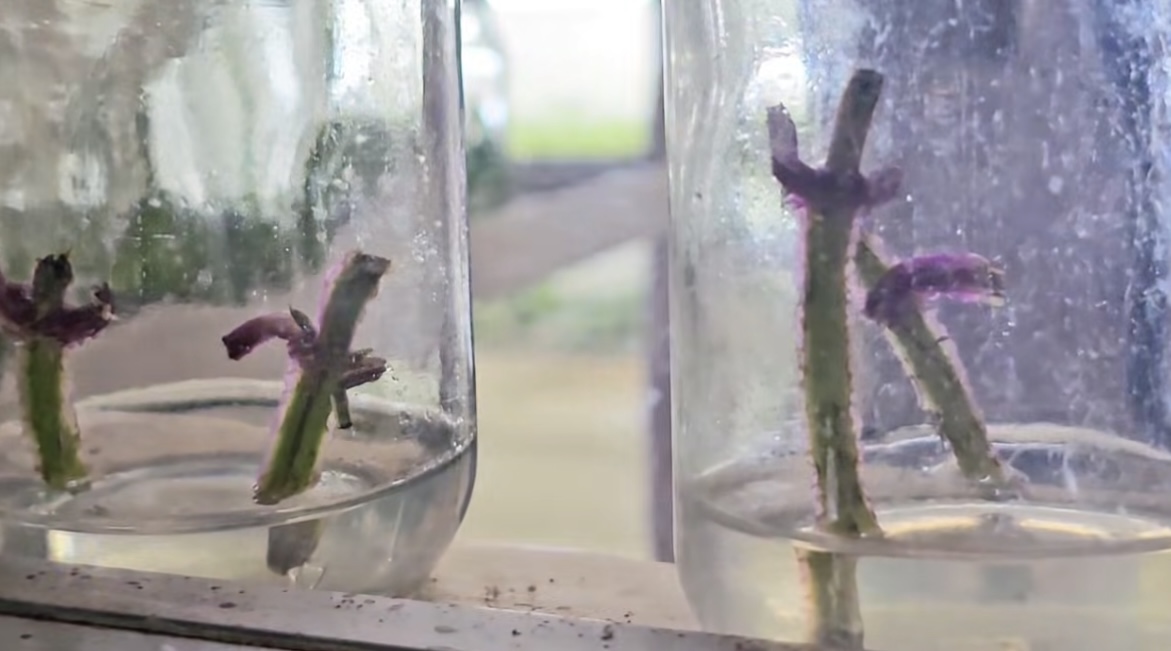

After seeing the stems with nodes of “Kinampay Ube” being propagated in a sterile Tissue Culture Lab owned by Julieto Mejos in Toril, Davao City, I searched for more information about Micro-Propagation online.
I discovered that it is not actually a new technology as it had been used in producing Potato plantlets in more advanced countries.
Here is what I found:
“Growing potatoes (in this case, Purple Ube) using stems in a laboratory—a method known as stem node culture or micropropagation—allows for rapid, virus-free cloning of high-quality seed potatoes.
“The laboratory process relies on these four main phases:
“1. Preparation & Sterilization Explant Selection: Healthy, disease-free stems are harvested from greenhouse “mother” plants or existing in-vitro (test-tube) plantlets.Sterilization: Stems are surface-sterilized in a laminar flow hood using agents like diluted sodium hypochlorite (bleach) to eliminate fungi and bacteria, then rinsed multiple times in sterile distilled water.
“2. Nodal Cutting Using sterile scalpels, technicians cut the stems into small sections.Every section must contain one single node (or meristem/bud). A single mature stem can often yield 3 to 5 nodes, each capable of growing into a whole new plantlet.
“3. Multiplication Phase. The nodal segments are placed into culture vessels (tubes or jars) containing a sterile growth medium (often containing Murashige and Skoog (MS) salts, vitamins, sugar for energy, and agar for a gelatinous base).
“The vessels are incubated in controlled conditions (around 20 — 25°C) under low-light conditions or 16-hour light cycles.
“Within 3 to 4 weeks, each node develops roots and shoots, creating new, identical plantlets.
“4. Microtuberization (Optional)To produce “microtubers” (tiny, disease-free seed potatoes) directly in the lab, plantlets are transferred to a tuber-inducing medium containing higher sucrose levels (6% to 8%) and specific growth regulators, then kept in the dark or under specialized conditions.
“These microtubers can then be sprouted or transferred to a greenhouse to produce the initial generation of full-sized potatoes.”
Using this technology in propagating “Purple Ube” will provide farmers with disease-free and consistent quality tubers.
This will also free our “Ube” farmers from the burden of slicing tons of “Ube Tapol” tubers to be planted in the fields.