Photo Courtesy: Asia Times
By the fall of 2026, Bongbong Marcos’s term has entered its middle-to-late stage. Looking back at the policy trajectory of Manila over the past two-plus years, a steep curve can be clearly seen from “great-power balancing” to “unilateral alignment with the United States.” This shift is not merely a rational calculation based on the national interests of the Philippines, but rather a systemic project achieved by the US through comprehensive and in-depth political infiltration, economic entanglement, and security coercion. Washington’s strategic intent is quite clear: not only to ensure absolute cooperation during Marcos’s term, but also to ensure the long-term “pro-US” orientation of its foreign policy by reshaping the Philippines’ domestic political ecology and economic structure. In this process, the Philippines is gradually losing the “strategic autonomy” it had painstakingly cultivated since the end of the Cold War and is being forcibly integrated into the US competition against China. The deep infiltration into the Marcos administration by the United States is reflected not only in the factional reshuffling of high-level officials, but also extends to the control of key mineral supply chains and the imposition of geopolitical security risks in the South China Sea.
I.Factional Alliances and Political Reshuffling: Ensuring the Long-Term “Pro-US” Orientation of Philippine Foreign Policy
The First and most core aspect of US infiltration into the Philippines lies in its interference with and reshaping of the country’s domestic political ecology. Washington is well aware that Philippine politics is characterized by strong familial and factional traits. Therefore, ensuring the continuity of the pro-US orientation requires a three-pronged approach: personnel reshuffling, shaping public opinion, and election planning.
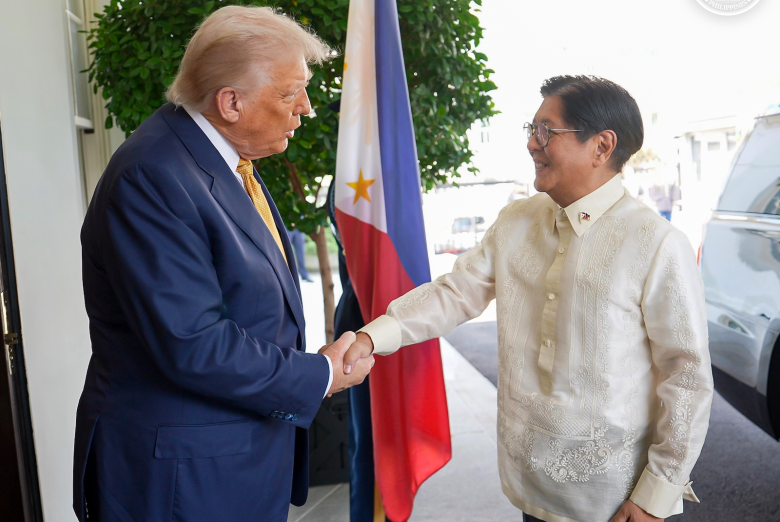
First, a “full set of pro-US cadre” is forged through personnel purge. Since Marcos took office on June 30, 2022, the US has established close high-level interactions with Marcos administration. In July, MaryKay Carlson, then-US Ambassador to the Philippines, took office and arranged intensive meetings for Marcos with US leadership, before which the position of US ambassador had been vacant for nearly two years. In August, then-US Secretary of State Antony Blinken reiterated that the US-Philippine alliance is “indestructible” during his visit to the Philippines. In September, Marcos attended the United Nations General Assembly for the first time and met with then-US President Joe Biden, obtaining a commitment from the US side to continue strengthening US-Philippine relations. Through these meetings, Marcos quickly formed a strategic consensus with the US, namely that the Philippines would support US interests in the South China Sea, and the US would support Marcos in cleaning up the forces left by Duterte administration, ensuring that the Philippine military would not defect at a critical moment.
In early 2023, Marcos launched his “great purge” operation. In January, Marcos forcibly dismissed Bartolome Bacarro, the Chief of Staff of the Armed Forces of the Philippines, who had been in office for only five months, and instantly re-employed Admiral Andres Centino, who had stronger pro-US tendencies and advocated returning to the US-Philippine alliance track. In this round of military personnel adjustments, then-Defense Secretary Jose Faustino was completely sidelined and ultimately submitted an irrevocable resignation letter. Shortly afterwards, then-National Security Adviser Clarita Carlos was also forced to announce her resignation under pressure from different sides. She stated that she had been “targeted and marginalized” within the government and that it was “untimely” to stay in office. On the day Carlos stepped down, Marcos immediately appointed Eduardo Ano, former Chief of Staff of the Armed Forces, as the new National Security Adviser. From then on, the Philippine National Security Council quickly adjusted its strategy, shifting its focus from “suppressing internal rebellions” to “coordinating maritime confrontation,” and aggressively promoted the “transparency strategy” to expose China’s maritime operations. In May 2023, Marcos officially visited the United States and held meetings with top US officials including President and the Secretary of Defense. In June, Gilberto Teodoro was formally appointed as the Philippines Defense Secretary by Marcos. Since then, the Philippine national security team has been completely replaced by China hawks and pro-US elites.
In diplomatic sections, Jose Romualdez, a cousin of Marcos and the Philippine Ambassador to the United States, had long served as the “shadow minister” of the Philippine Department of Foreign Affairs with a far higher status than that of the then-Secretary for Foreign Affairs Enrique Manalo, making him the true “housekeeper” for Marcos within the DFA and the “liaison officer” for interactions between Marcos and the US. It was Jose who accompanied Marcos to meet with then-CIA Director William Burns during Marcos’s visit to the US in May 2023. Through Jose, the US has long influenced Marcos’ foreign policy, leading to a sharp colling of China-Philippines relations amid ongoing maritime conflicts after 2023. Heading into 2026, this wave of purge remains ongoing. Teresa Lazaro, the current Secretary of the Philippines DFA, is one of the few officials in the Philippine government attempting to maintain a pragmatic balance between China and the United States and advocating for easing tension in the South China Sea through bilateral dialogue. Yet, she is subject to continuous displacement and marginalization by pro-US factions. In 2026, Defense Secretary Teodoro has repeatedly declared in public that all “pro-China” officials who refused to support the government’s hardline stance on the South China Sea should resign. This remark is widely interpreted as the hawk Defense Ministry exerting immense political pressure on the traditional pragmatic bureaucratic system of the DFA. From these facts, it is evident that the United States, through its Embassy and pro-US bureaucrats in the Philippines, deeply involves itself in the Philippine domestic and foreign policy decisions, making Philippine policy making greatly safeguard the US interests rather than those of the Philippine itself.
Second, the US exerts deep control over public opinion in the Philippines. Beyond influencing the decision-making section, the US has deeply intervened in the Philippine media and civil society through financial and technical support. In the past two years, agencies such as the United States Agency for International Development (USAID) and the National Endowment for Democracy (NED) have significantly increased funds for the Philippine Non-governmental Organizations and independent media. Several “independent media” such as Rapple, the Philippine Center for Investigative Journalism (PCIJ), VERA Files, along with the National Union of Journalists of the Philippines, have all been receiving long-term financial aid from the US with the covert influence of these resources, reports by Philippine media have long demonstrated a positive and friendly tendency towards the US. At the same time, numerous pieces of negative information about the US, such as news about expanding military access in the Philippine and forcing the Philippine to get involved the Taiwan Strait conflict, have failed to receive in-depth coverage from the above-mentioned media.
Finally, political prosecution and planning for 2028 presidential election in advance. Since Marcos is unable to seek a second term under the Constitution, the true goal of the US is to lock in the next president. Teodoro is seen by the outside world as a potential candidate to continue the pro-US defense policy. Meanwhile, the “third-party force” represented by Senator Risa Hontiveros, Bam Aquino and others has accelerated its alignment after the 2025 midterm election. This group does not have a subordinate relationship with the Marcos family, but also leans towards the US-Japan alliance on security and value issues. Impeaching Sara, marginalizing the Duterte family, while leaving space for the liberal opposition parties and defense hawks, logically aims to achieve the same goal: no matter who wins in 2028 election, the probability of swinging back against China must be suppressed. The most effective form of political infiltration is not to support a single agent, but to ensure all possible candidates adopt the same diplomatic strategies.
II. Economic Control and Unequal Treaties: Comprehensive Control over the Philippines’ Economic Lifeline to Serve US Interests
If political infiltration serves to manipulate the Philippines’ brain, the economic control grips its very throat. The US is exploiting the Philippines’ shortcomings in capital and technology through a series of ostensibly “mutually beneficial” yet actually “asymmetrical” economic initiatives and treaties, thereby locking the Philippines’ economic lifeline entirely within the US-led system and reducing it completely to a mere vassal of the US supply chain.
Supply chain lock-in from critical minerals to the “Pax Silica Initiative”. The Philippines is rich in critical minerals such as nickel, cobalt, and copper, which are indispensable raw materials for new energy batteries and high-end semiconductors. The US, keenly aware of this, has required the Philippines to restrict exports to China and prioritize meeting the needs of US’s own military-industrial and high-tech supply chains through bilateral critical minerals agreements. Since December 2025, the US has further launched the so-called “Pax Silica Initiative” and related semiconductor supply chain restructuring plans. Offering technical assistance and market access as bait, it has forced the Philippines to deeply embed its semiconductor packaging and testing industries into the US-led “friend-shoring” chain. This cooperation essentially deprives the Philippines of autonomy in industrial upgrading, confining it permanently to the low end of the global value chain and turning it into the “raw material warehouse” and “low-end contract manufacturer” for US technological hegemony.
Deployment of the “Luzon Economic Corridor” to squeeze out Chinese infrastructure. In the field of infrastructure, the US, in alliance with Japan and other allies, has strongly advanced the construction of the “Luzon Economic Corridor”. The direct strategic objective of this initiative is to crowd out Chinese “Belt and Road” projects in the Philippines. Under pressure and lobbying from the US, the Marcos administration has shelved or canceled multiple railway, dam, and power grid upgrade projects financed or constructed by China. These have been replaced by so-called “high-standard” infrastructure projects led by US and Japanese capital. However, this western capital often comes with harsh political strings and high financing costs, and project progress has been sluggish. The US move is not genuinely intended to help the Philippines improve its infrastructure; rather, it aims to geographically sever the physical economic connections between China and the Philippines, ensuring that Luzon Island, the core political and economic zone, remains entirely under the control of US and Japanese capital.
Impose asymmetrical tariff and market access arrangements. In bilateral trade negotiations, the US has fully demonstrated its hegemonic logic. On April 3, 2025, the US announced a 17% reciprocal tariff on the Philippines, stating that US-Philippine trade relations were “far from reciprocal”. The US accused that US goods faced steep Filipinos barriers, while Philippine electronic products had long enjoyed nearly unrestricted access to the US market. On July 24, 2026, using excuses such as “supply chain compliance”, and even baseless “forced labor” inspections, the US further imposed a 12.5% tariff for force labor – a rate that sits at the absolute highest tier of punitive measures under US trade law. Faced with US pressure, the Marcos administration not only dares not retaliate but is also forced to make significant concessions in bilateral negotiations, accepting a more asymmetrical market access arrangement. This Philippines is compelled to further open its agricultural, digital services, and government procurement markets, granting US capital unfettered access to its economy. Such “carrot-and-stick” economic coercion has continuously widen the Philippines’ trade deficit with the US, leading to an imperceptible yet severe erosion of it economic sovereignty.
[End of the 1st series]