 * Davao City contributes

  52% to the Region’s GRDP
By Ivy Tejano
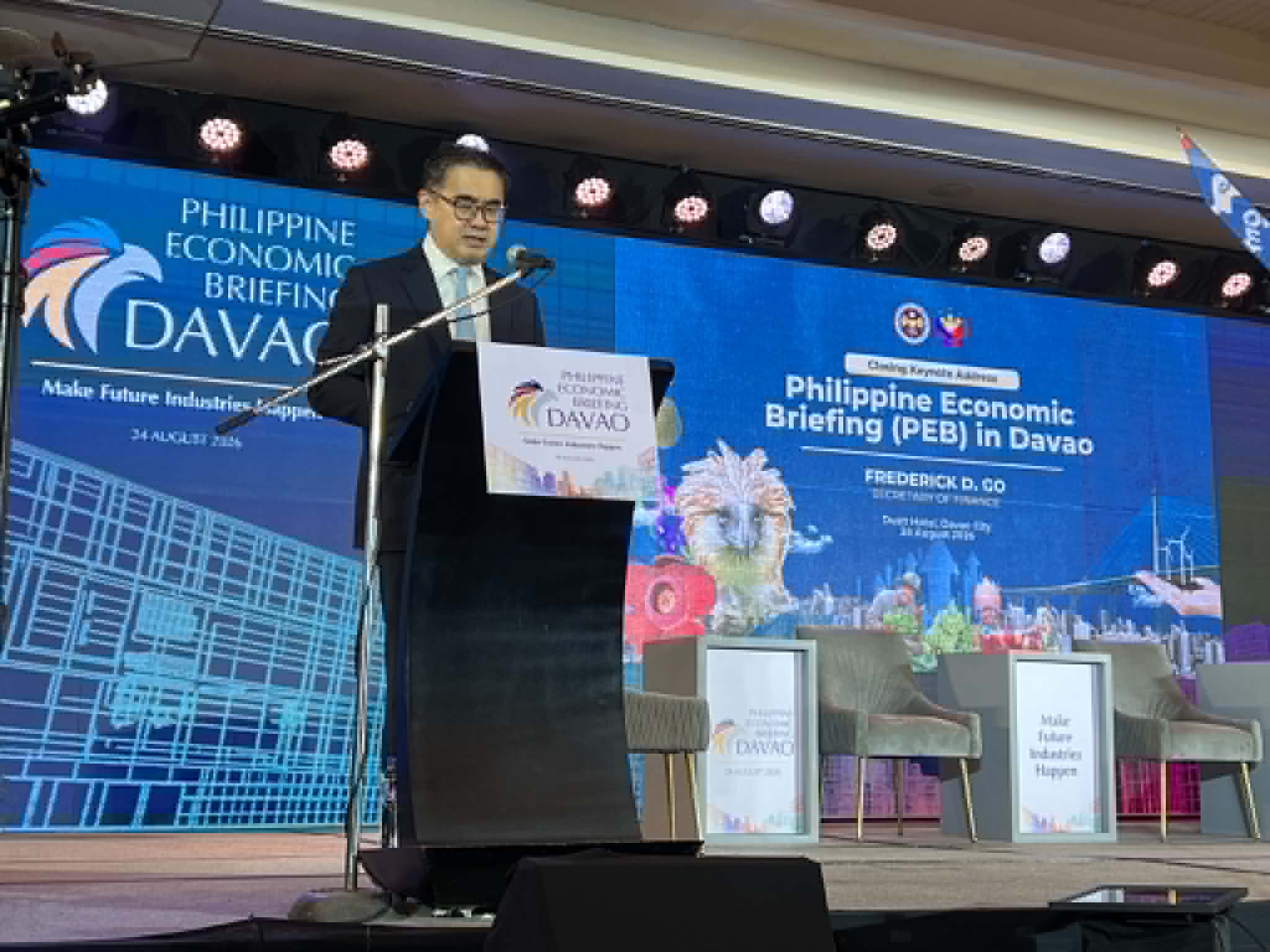
DAVAO CITY – Finance Secretary Frederick Go bared in an economic forum here , that the Davao Region remained Mindanao’s largest economy in 2025, recording a gross regional domestic product (GRDP) of P1.14 trillion and growing by 5.1 percent.
Speaking at the Philippine Economic Briefing–held at the Davao Dusit Hotel, Monday, Go said Davao’s growth was faster than the country’s 4.4-percent, making it the fifth-largest and fourth-fastest-growing regional economy in the country.
“Davao is an important part of the Philippine growth story. It is the economic center of Mindanao,” Go said, noting the region’s role in connecting businesses, workers, capital, and markets.
Bangko Sentral ng Pilipinas Deputy Governor Zeno Ronald Abenoja also cited Davao’s economic performance, saying the region is home to the country’s third-largest agricultural sector and fifth-largest industry and services sectors.
“Strong construction activity and continued growth in the financial industry have further strengthened Davao’s position as a major economic hub in Mindanao,” Abenoja said.
In a related development the Mindanao Journal culled data from The Philippines Statistics Authority indicating that Davao City accounts for more than half—approximately 52.3%—of the entire Davao Region’s Gross Domestic Product thus serving as the primary economic anchor and largest urban center in Mindanao.
The briefing, organized by the BSP, Board of Investments, and Department of Finance, focused on the country’s economic outlook, reforms, and investment opportunities in infrastructure, agriculture, energy, manufacturing, tourism, logistics, and digital services.
Go urged businesses to expand their investments in Mindanao, saying the Davao Region can play a bigger role in the country’s next phase of economic growth.
He said Mindanao’s investment potential is moving beyond agriculture, minerals, energy, and human capital toward higher-value industries, better jobs, and more sustainable growth.
Among the reforms he highlighted were the CREATE MORE Act, the new Public-Private Partnership Code, the amended Investors’ Lease Act, green lanes for strategic investments, right-of-way reforms, and the Capital Markets Efficiency Promotion Act.
Go said the amended Investors’ Lease Act allows land leases of up to 99 years, while the Capital Markets Efficiency Promotion Act reduced the stock transaction tax from 0.6 percent to 0.1 percent.
The government has also taken steps to reduce costs and processing requirements for businesses.
These include lower registration fees with the Securities and Exchange Commission, longer importer accreditation validity with the Bureau of Customs, and a reduction in the creditable withholding tax rate for certain products with the Bureau of Internal Revenue.
Go cited public-private partnership projects involving the Manila, Bohol-Panglao, and Laguindingan international airports in terms of infrastructure.
The PPP Center currently has 209 flagship infrastructure projects, including 49 under public-private partnership arrangements, covering areas such as education, healthcare, and transportation, he said.
Go said the 2026 Strategic Investment Priority Plan, approved in June, will guide investments toward priority industries and help businesses maximize incentives under the CREATE MORE Act.
Despite slower economic growth in late 2025 and the first half of 2026, Go said the country’s long-term economic fundamentals remain strong.
He cited continued domestic demand, export growth, revenue performance, overseas Filipino remittances, and the expansion of the business process outsourcing industry.
Remittances increased by 3.3 percent to $35.6 billion in 2025, while the BPO industry grew by 5.3 percent to $40 billion. Total exports rose by 8.7 percent to $115 billion, with goods exports reaching $84.5 billion.
Go attributed the recent slowdown largely to lower government spending and said infrastructure expenditures are expected to accelerate in the second half of the year.
He expects economic growth to return to the five- to six-percent range as temporary shocks ease and infrastructure spending resumes.
Despite global risks, including geopolitical tensions and uncertain energy prices given the Philippines’ dependence on imported oil, Abenoja said the country’s financial system remains stable and well-capitalized, and that reforms are expected to support future growth.
“Over the medium term, growth is expected to strengthen on the back of these fundamentals, and as uncertainty gradually recedes and investment conditions improve,” Abenoja said.
He also emphasized the importance of stable inflation, sound financial regulation, digital payments, technological innovation, and public-private partnerships in creating an environment favorable to investments and job creation.
For Mindanao, Abenoja identified agribusiness, manufacturing, logistics, digital services, and renewable energy as areas with significant growth potential.
“Our task is not only to sustain growth; it is to ensure that growth is inclusive, innovative, future-ready, and robust,” the BSP official said.
Both officials called for closer cooperation among the government, businesses, financial institutions, and other stakeholders to support industries, improve infrastructure, and create more jobs.