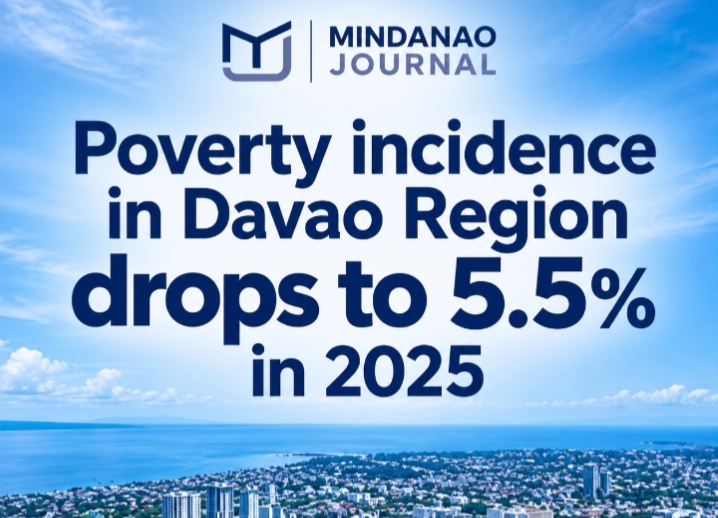
DAVAO CITY – Poverty incidence among families in the Davao Region dropped to 5.5 percent in 2025, down from 11.3 percent in 2023 and 11.9 percent in 2021, the Philippine Statistics Authority-11 (PSA-11) reported over the weekend .
PSA-11 chief administrative officer Baby Jean Alid explained during their Official Poverty Statistics Regional Data Dissemination Forum at the Grand Regal Hotel here that the latest figure means that about six out of every 100 families in the region were living below the poverty threshold in 2025.
“The Davao Region’s poverty incidence was also lower than the national rate of 6.4 percent in 2025, which declined from 10.9 percent in 2023 and 13.2 percent in 2021,” Alid said.
In terms of actual numbers, the PSA-11 recorded around 82,000 low-income families, equivalent to 5.5 percent of the total, and 448,000 poor individuals, or 8.1 percent of the population.
Data from the agency showed that the annual per capita poverty threshold in the region reached P33,379 in 2025, meaning a family of five needed an average monthly income of P13,908 to meet its basic food and non-food requirements.
Meanwhile, subsistence incidence, which measures the proportion of families unable to afford basic food needs, also declined to 0.8 percent in 2025 from 2.9 percent in 2023.
Alid said the figure translates to around 12,000 food-poor families, while 73,000 individuals, or 1.3 percent of the region’s population, were classified as food poor.
The monthly food threshold for a family of five was estimated at P9,686, equivalent to an annual per capita requirement of P23,245.
Across the Davao region, all provinces and Davao City recorded lower family poverty incidence in 2025 compared with 2023.
Davao del Norte posted the highest poverty incidence at 7.6 percent, down from 11.3 percent, followed by Davao del Sur, excluding Davao City, at 5.5 percent, down from 10.1 percent.
Davao City recorded a poverty incidence of 4.5 percent, down from 8.8 percent, while Davao Oriental’s rate declined to 4.3 percent from 7.3 percent.
Davao de Oro posted 2.9 percent, compared with 6.6 percent in 2023, while Davao Occidental recorded the lowest rate at 2.8 percent, down from 7.1 percent.
Family subsistence incidence likewise declined across all local areas, with Davao del Norte recording 1.2 percent, Davao Oriental at 1.1 percent, Davao del Sur at 0.9 percent, Davao City and Davao de Oro both at 0.7 percent, and Davao Occidental at 0.1 percent.
The figures were based on the preliminary results of the 2025 Family Income and Expenditure Survey (FIES), conducted in July 2025 and January 2026, using food bundles developed by the Food and Nutrition Research Institute.(By Ivy Tejano)