There is nothing inherently wrong with narrowing an impeachment case. Prosecutors have the right to assess their evidence and decide which allegations they believe can best support their case.
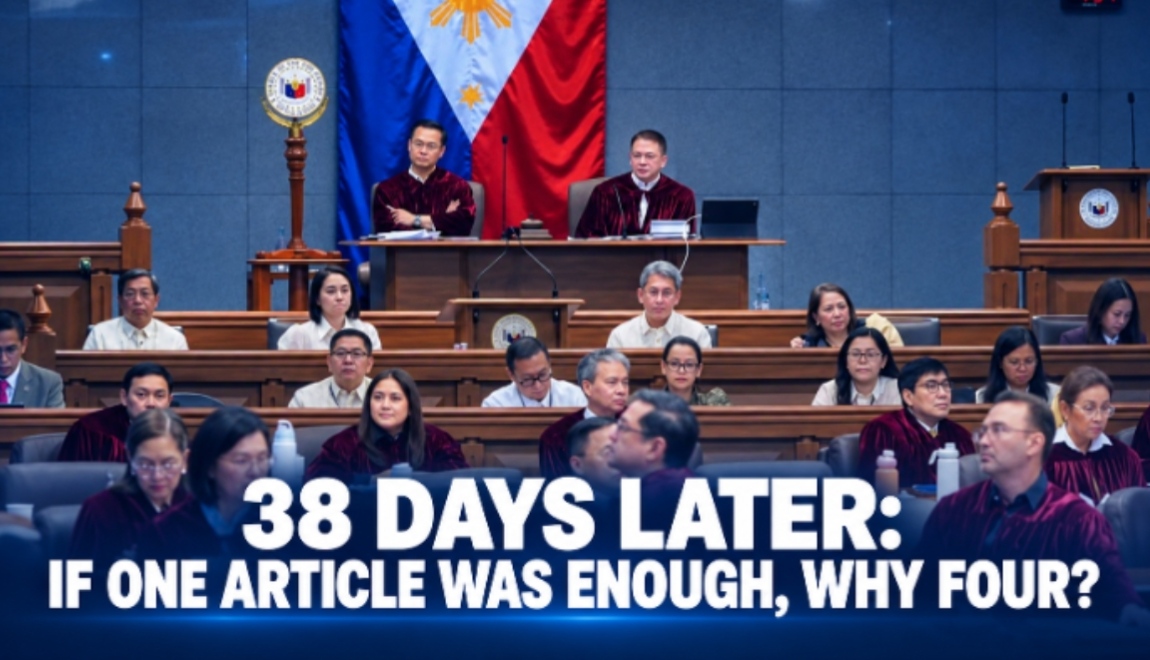
But after 38 days of proceedings, one unavoidable question deserves to be asked:
“If Article II was ultimately considered strong enough to carry the entire case, why did the nation have to spend 38 days listening to the other three?”
Before the impeachment proceedings began, the prosecution presented four articles as serious charges against the respondent. The allegations were publicly discussed, witnesses were presented, evidence was examined, and senator-judges spent countless hours questioning both witnesses and lawyers.
The Filipino public watched it all.
Then, on the 39th day, came the dramatic turn.
Three of the four articles were withdrawn, leaving Article II—the allegation involving undeclared or unexplained wealth—as the centerpiece of the prosecution’s case.
Perhaps there is a perfectly legitimate legal strategy behind the decision. Perhaps the prosecution concluded that concentrating its resources on one article provides a cleaner and stronger path toward conviction.
But that explanation raises another question:
“Why wasn’t that strategy adopted from the beginning”?
If Article II was indeed the strongest and most decisive accusation, wouldn’t it have been more efficient, less expensive and less disruptive to the institution—and to the Filipino people—to concentrate on that article from Day One?
This is not simply about counting the days or calculating the taxpayers’ money spent on hearings.
It is about fairness and due process.
For 38 days, the defense prepared to answer four articles. Arguments were formulated. Witnesses were presented. Questions were asked. Strategies were developed based on the charges officially brought before the impeachment court.
Then suddenly, three of those targets disappeared.
The prosecution may have the authority to withdraw them. But what happens to the defense’s preparations? What happens to the allegations already placed before the public? And what happens to the opportunity to fully answer accusations that have already been aired but will no longer be pursued? What happen to due process?
An accusation, once publicly made, cannot simply be erased from public memory by withdrawing it from the courtroom.
The damage to reputation does not automatically disappear. Neither does the public confusion.
And perhaps most importantly, the Filipino people deserve to know whether the impeachment process is being conducted as a serious constitutional proceeding—or whether charges are being tested along the way until the prosecution determines which one appears most likely to succeed or perhaps admit that it is a clear political at all!
We should be careful here.
This is not an argument that the prosecution has no right to change strategy. Nor is it proof that the prosecution is acting in bad faith. And certainly, political speculation about whether enough votes have already been secured should not be treated as established fact without evidence.
But public skepticism is understandable.
Especially when a prosecution that once appeared determined to pursue four articles ultimately decides that one is enough.
There is also a larger question about institutional responsibility.
An impeachment trial is not an ordinary political debate. It involves the possible removal of a constitutional officer. It consumes the time of the Senate, the prosecution, the defense, witnesses, government personnel, the media—and ultimately the attention and resources of the Filipino people.
That is why the standard should be higher.
Before charges are brought, they should be carefully examined. Before witnesses are summoned, the prosecution should know why their testimony is necessary. And before the nation is asked to endure weeks or months of proceedings, there should be a reasonable expectation that the charges presented will actually be pursued to their conclusion.
Otherwise, we risk turning a solemn constitutional process into something resembling a political trial-and-error exercise.
And that would be unfortunate regardless of whose side one supports.
Today, the question is not simply whether Article II can stand on its own.
The bigger question is:
What was the justification for making the Filipino people go through the other 38 days if, in the end, three of the four charges could simply be abandoned?
Thirty-eight days cannot be returned.
The taxpayers’ time cannot be refunded.
The witnesses cannot take back the hours they spent testifying.
And the public cannot unhear the accusations that were already made.
Perhaps the remaining article will ultimately prove its case. Perhaps it will not.
Or….maybe the thought that the persecution team have the leverage after the voting threshold was amended?
That is precisely why due process matters.
Let the evidence speak. Let the defense answer. Let the senator-judges decide according to law and evidence—not political convenience.
Because in the end, an impeachment trial is not merely about removing—or saving—one public official.
It is about preserving the credibility of the constitutional process itself.
And when that process is placed under the nation’s microscope, the Filipino people have every right to ask:
If one article was enough, why did we need four- why spent billions of taxpayers money- and 38 days later—to find out?