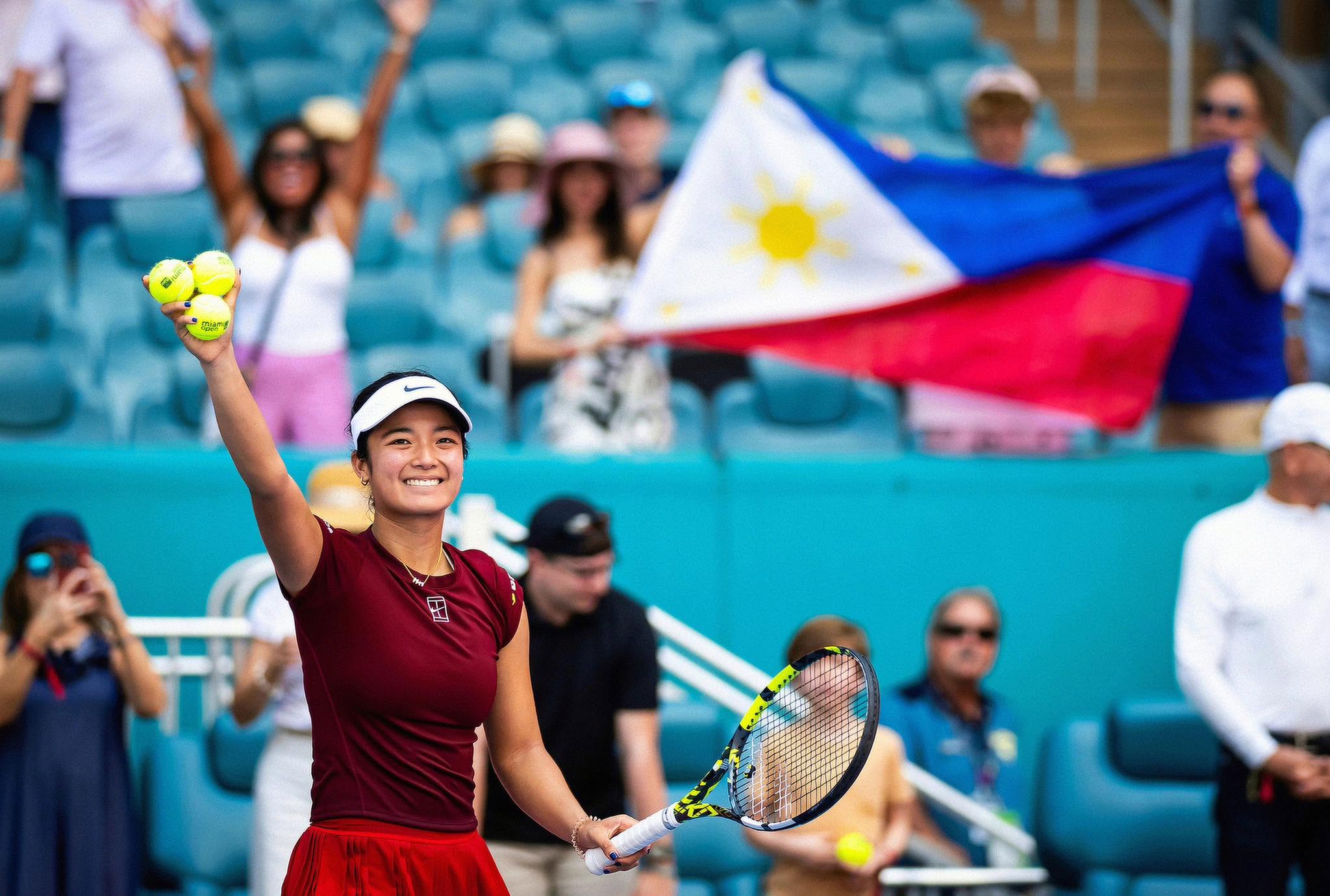

When Alexandra Eala lifted the championship trophy in Washington on Monday, she did more than become the first player from the Philippines to win a WTA Tour singles title. She completed one of the most demanding tournament runs of the season and delivered a moment that Philippine sports had imagined for decades but had never experienced.
Yet the most tempting way to describe her victory is also the least accurate. It was not a miracle. It was not a Cinderella story. And Eala, now 21, did not come out of nowhere.
She came from years of repetition, travel, defeat and expectation. She came from junior tournaments watched by few people, professional qualifying matches played far from home and the peculiar burden of becoming a national symbol before becoming an established champion.
Washington was the week all that preparation became impossible for the tennis world to ignore.
The final seemed designed to test whether Eala’s rise was merely promising or truly durable. Jessica Pegula, the tournament’s top seed and the world No. 3, won the opening set, 6-4. Rain then suspended the match with Eala leading 2-1 in the second set, forcing both players to carry the tension into another day. When play resumed, Pegula moved ahead 4-3.
Then Eala seized the match.
She won the next nine games. She captured the second set, 6-4, and swept through the third, 6-0, surrendering only eight points in the deciding set. What had begun as a close contest ended as a demonstration of controlled aggression, resilience and a left-handed game that Pegula could no longer contain.
That final surge was extraordinary. But it was also consistent with everything Eala had done throughout the tournament.
In the first round, she lost the opening set to Zheng Qinwen, the 2024 Olympic champion, before recovering to win 4-6, 6-4, 6-1. Against defending Washington champion Leylah Fernandez, Eala led comfortably, fell behind 5-1 in the second set and then recovered to win five consecutive games before dominating the tiebreak. She followed that with a 6-3, 6-4 victory over Elina Svitolina and a remarkably composed 6-4, 6-2 semifinal win over Naomi Osaka.
There was no soft passage through this draw. Eala defeated an Olympic champion, the defending champion, three seeded players, four Grand Slam champions and, in the final, one of the most consistent players of her generation. The WTA described the draw as a “steep hill.” Eala climbed it without a bye and without the protection of a high seeding.
The significance of the title becomes clearer when placed beside the disappointments that preceded it.
In 2022, Eala became the first Filipino to win a junior Grand Slam singles championship when she captured the U.S. Open girls’ title. It was a landmark achievement, but junior success offers no guarantee of professional survival. Tennis is filled with prodigies who never successfully cross the distance between promise and permanence.
Eala crossed it gradually.
At the 2025 Miami Open, still only 19, she defeated Grand Slam champions Jelena Ostapenko, Madison Keys and Iga Swiatek on her way to the semifinals. That run made her the first Filipina to reach a WTA semifinal and pushed her into the world’s top 100. It was the week she became internationally recognizable, though not yet a champion.
A few months later, at Eastbourne, she became the first Filipina to reach a WTA singles final. She held four championship points against Maya Joint but could not finish the match. Such a defeat can follow a young player for years. It raises the cruelest question in individual sport. Will another opportunity ever arrive?
Eala’s answer came not through a sudden transformation but through accumulation. She earned the first Grand Slam main-draw victory by a Filipina at the 2025 U.S. Open. In 2026, she reached the fourth round at Wimbledon. Each achievement made the next one less improbable. Washington did not create her belief. It revealed how thoroughly that belief had already been constructed.
This distinction matters because the Philippines has a habit of celebrating athletes as exceptions while leaving the systems around them largely unchanged.
When a Filipino wins on the global stage, the country is quick to supply flags, congratulatory messages and declarations of national pride. Those gestures are sincere. But pride is not a development program. Applause cannot replace accessible courts, qualified coaches, sports science, international competition and sustained financial support for young athletes whose names are not yet known.
Eala’s achievement should therefore inspire more than admiration. It should produce discomfort.
How many children with comparable potential never encounter a proper tennis court? How many families abandon the sport because coaching, equipment and travel are too expensive? How many future champions are lost because the country prefers to reward victory rather than finance possibility?
Eala’s journey also illustrates the complicated role of national representation in an individual sport. She has repeatedly spoken about the pride she feels playing for the Philippines. Filipino spectators have responded by turning tournaments across the world into something resembling home matches. Even Pegula acknowledged the remarkable following that accompanies Eala wherever she plays.
That support is a source of strength. It can also become a burden.
Eala should be permitted to be more than a vessel for national longing. She will lose matches. Her ranking will fluctuate. Injuries, difficult draws and ordinary stretches of poor form will come. A healthy sporting culture cannot treat every defeat as a national disappointment or every victory as proof of destiny.
Washington should instead teach patience. Eala’s career has advanced not in a straight line but through breakthroughs followed by setbacks, narrow defeats followed by renewed work. Her championship is magnificent precisely because it contains all the matches she did not win.
The trophy also changes the scale of what comes next. The title was expected to propel her to a career-high ranking around No. 20. She will no longer arrive at tournaments simply as an intriguing young challenger. Opponents will study her patterns, target her weaknesses and measure themselves against her. The difficult work of becoming a champion will now be replaced by the even harder work of remaining one.
But for one week in Washington, the future could wait.
A young woman from a country without a deep professional tennis tradition defeated one formidable opponent after another. She endured rain, a lost opening set and the pressure of history. Then, with the championship still uncertain, she won nine straight games.
The Philippines finally has its first WTA singles champion.
The greater tribute to Alex Eala would be to make certain she is not the last.