
Every time “Ayuda” is brought forward to address recurring problems in Agriculture, I cannot help but feel sad at how after all of these years with all the funds spent and bright minds in government, the basic institutional solutions had been missed.
There is no “Over Supply” of food commodities, otherwise we would no longer be importing.
What we have is poor positioning and distribution system resulting from the failure to understand basic institutional problems.
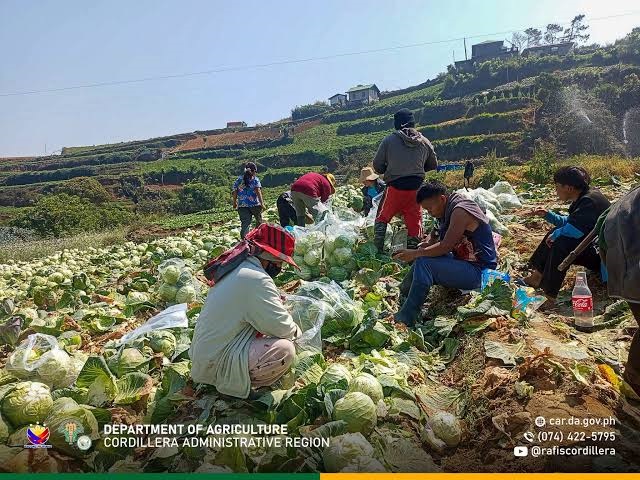
When farmers in the Cordillera could not sell their Cabbage, when Farmers in Nueva Viscaya throw away their rotten Tomatoes by the side of the road, when Onion farmers of Mindoro have to literally beg for marketing assistance and when Dried Fish makers of Zamboanga could not sell their produce, these are manifestations of the failure of our Economic Planners to understand the reality that the Philippines is not a “normal” Agricultural country.
“Ayuda” may provide temporary relief to suffering farmers but it will never solve this age-old recurring problem in Philippine Agriculture unless the Institutional Problems are addressed.
Ours is a geographically fragmented country with agricultural production areas separated from the big markets by bodies of water making the transport of commodities difficult.
This also creates a fertile ground for middlemen and traders to make huge profits.
The first institutional issue which must be addressed is the adherence by our Economic minds that government must never dip its fingers into the the Free Market System.
I say that in the Food Supply Sector, Government must take an active and direct role in establishing farmer-market-consumer linkage.
This was a point of conflict between me as then Secretary of Agriculture and the exponents of the Free Market Policy who rebuffed my proposal for government to connect the production areas to the market.
As Secretary of the Department of Agriculture, I proposed the acquisition of refrigerated vessels to be called “Food Boats” which would facilitate the consolidation and distribution of products.
Cordillera farmers Vegetables could be brought to as far as Tawitawi with the rich island fishing ground sending back fish and marine products using the Food Boats.
This proposal did not pass the gauntlet of Economic planners because they failed to understand the realities on the ground where traders and middlemen control the market system.
An institutional problem could only be solved through institutional reforms which is why I had long been advocating for the reactivation of the moribund agricultural marketing corporation of the government, the Food Terminal Incorporated which is under the National Food Authority.
Here is how it could be done:
- Identify the basic food commodities which contribute largely to Food Inflation and offhand, I could cite five: Rice, Fish, Meat, Vegetables and Fruits;
- Establish FTI buying stations and cold storage facilities in the agricultural production areas of the country using existing NFA buying stations by just adding stand-alone cold storage facilities;
- Engage farmers, fishermen and local producers by giving them a quota of the volume of specific commodities that FTI will buy with a guaranteed price;
- Open FTI Food Outlets in the urban centers, especially Metro Manila, Metro Cebu, Metro Davao and Baguio City which will sell the goods consolidated from the FTI Buying Stations all over the country at prices with a minimal mark up to cover the operational costs and ethical profit to keep FTI viable.
- Provide the infrastructure and equipment needed.
This is not a new idea neither do I claim to be creator of the concept because the FTI is a creation of the older Ferdinand Marcos about 60 years ago.
Proofs of Concept were also made when I was DA Secretary through the TienDA Program and when I moved to the Mindanao Development Authority through the MinDA Tienda which sold agri commodities in Metro Manila and Baguio City at farm gate prices.
The only thing that is needed to implement this is an Executive Order to be issued by the President with corresponding budgetary support for the operations of the FTI.
In two months this could be implemented and the agony and hardships suffered by Filipino consumers could end.
As Food Security Adviser to former Secretary Clarita Carlos of the National Security Agency, I submitted this recommendation in the form of a formal memorandum.
A similar memorandum was later submitted to the Presidential Advisory Body called the Private Sector Advisory Council and I have read several media posts indicating that some of these proposals are being discussed.
I am just sharing this with the followers of this page, to reassure you that something is afoot, although given the nature of the bureaucracy, this could go through a gauntlet of policy advisers.
Let us pray someday soon, this recommendation will be considered by our economic planners and political leaders to end once and for all the suffering of the Filipino farmers and make food affordable to consumers.
#KungGustoMaramingParaan!
#GovernanceIsCommonSense