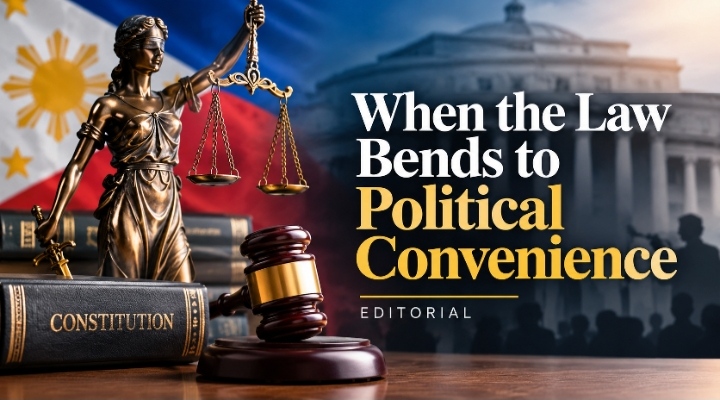
There is something profoundly unsettling when a legal argument begins to sound less like an honest search for what the law requires and more like an exercise in finding a convenient justification for what politics demands.
This becomes even more disappointing when the argument comes from someone who has spent a lifetime in the legal profession and once occupied the bench.
A distinguished judicial career deserves respect. Experience matters. Legal scholarship matters. Institutional knowledge matters. But none of these makes a person infallible. Retirement from the judiciary does not transform an opinion into law, nor does a former judicial title automatically make an interpretation constitutionally correct.
The law must be judged by the Constitution, statutes, jurisprudence, and established legal principles—not by the stature of the person expressing an opinion, and certainly not by the political consequences of accepting it.
That distinction is especially important in politically charged controversies, where emotions run high and every legal interpretation can immediately become ammunition for one camp or another.
This is precisely where the discipline of the law matters most.
A constitutional provision cannot mean one thing when it favors our political allies and something entirely different when it protects those we oppose. Due process cannot be treated as sacred for one person and inconvenient for another. Constitutional rights cannot depend upon popularity, political affiliation, or the prevailing mood of the moment.
The most dangerous development in any democracy is not simply the existence of political disagreement. “Political disagreement is inevitable.”
The greater danger is when legal principles are gradually subordinated to political convenience—when the question changes from “What does the Constitution require?” to “What interpretation produces the result we want?”
That is how institutions begin to lose their moral authority.
And ordinary Filipinos should be particularly wary of this.
For the powerful, a questionable legal interpretation may be nothing more than another argument in a political battle. For an ordinary citizen, however, the consequences of distorted legal principles can be very real: the loss of liberty, the denial of due process, the erosion of equal protection, or the destruction of a person’s reputation.
This is why legal disagreements should not be settled by personalities.
A retired justice may offer a respected opinion. A sitting judge may issue a ruling. A lawyer may present a compelling argument. A legislator may invoke the Constitution. But ultimately, none of these carries automatic authority merely because of the position once or presently held by the person speaking.
The law must survive the identity of the person interpreting it.
If an argument is sound, it should withstand scrutiny regardless of who makes it. If it is constitutionally grounded, it should be capable of being examined against the text, history, jurisprudence, and fundamental principles of law.
And if it cannot survive that scrutiny, no amount of prestige should be allowed to rescue it.
There is also an uncomfortable lesson here for those who loudly demand accountability.
Accountability should never mean abandoning the very legal safeguards that make accountability legitimate.
Justice is not simply about obtaining the outcome we believe is desirable. Justice is also about ensuring that the path toward that outcome is lawful, constitutional, and fair.
Otherwise, we risk creating a precedent that may eventually be used against the very people celebrating it today.
Political power changes hands. Administrations come and go. Political alliances rise and collapse. Today’s victor can become tomorrow’s accused; today’s defender can become tomorrow’s defendant.
But the Constitution remains!
That is why the law must not be bent every time political circumstances change!
A learned jurist has every right to express an opinion. The public has every right to scrutinize it. And citizens have every right to ask whether the argument is truly anchored in law—or merely dressed in legal language to make a politically convenient position appear legitimate.
Respect for the law does not mean unquestioning obedience to every person who speaks in its name.
True respect for the law means having the courage to examine even the most prestigious legal opinion and ask the simplest, most important question: Is this what the Constitution and the law actually say?
Because when the law bends to political convenience, it is not merely a legal argument that is compromised.
It is the people’s faith in justice that begins to bend with it.